
How to Develop the Right Foundation Shade Range for Your Target Market
“Building a foundation line gets tricky fast: to help customers find right shade of foundation, brands need more than fair, medium, and deep labels. Real complexions bring cool pink, warm golden, neutral, peach, and olive undertones into the mix.
For private-label buyers, that colorful puzzle lands on the factory floor. Custom color matching, pigment blending, batch consistency, and stable formulas turn a shade plan into repeatable production. Review foundation SPF guidance, clumping prevention, skin-care foundation development, Chinese foundation trends, base makeup guidance, and qualified manufacturer guidance. The FDA cosmetics overview helps define the category.
Key Points to Find Right Shade of Foundation
➔ Determine Skin Depth & Undertone: Segment fair, medium, deep ranges and classify cool pink, warm golden, neutral, peach, or olive casts.
➔ Ensure Batch Consistency: Implement bulk pigment blending and stability tests to maintain uniform pay-off and undertone fidelity across runs.
➔ Optimize Formulation & Packaging: Choose liquid or matte bases to suit clientele and select airless pumps or droppers to protect shade integrity.
➔ Comply & Communicate: Adhere to dermatologist testing, non-comedogenic, cruelty-free, and vegan standards, and use clear labeling for seamless e-commerce fulfillment.
Data Shows 30% More Brands Help Customers Find Right Shade Of Foundation
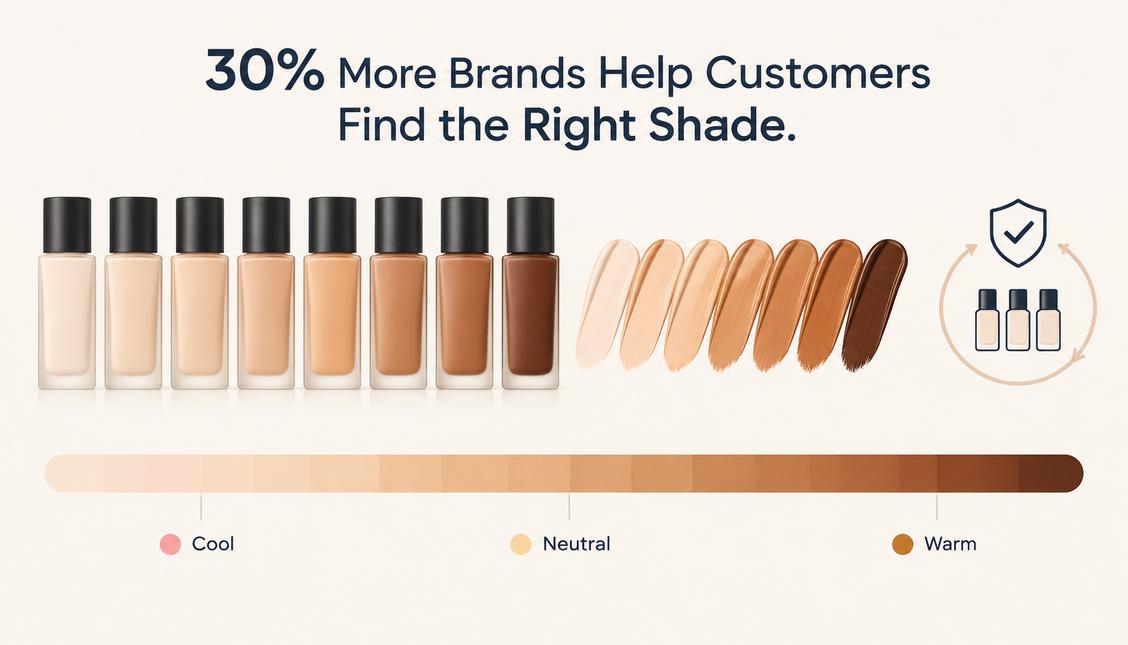
A range that skips undertones or shifts between batches makes matching difficult.
How bulk pigment blending boosts shade range diversity
Strong pigment blending starts before foundation reaches a bottle. During bulk production, manufacturers can adjust base pigments across light-to-deep values instead of stretching a few colors over many skin tones.
- Range development
- Color formulation changes red, yellow, black, and white pigment levels in controlled amounts. US color planning should follow the FDA color-additive guidance.
- Those changes increase shade diversity, helping more shoppers find right shade of foundation without settling for “close enough.”
- Commercial production
- Careful cosmetic manufacturing preserves the planned undertones as formulas scale up.
- Topfeel Beauty supports custom shade development and bulk manufacturing, giving brands room to build broader foundation ranges.
That wider color map makes it easier to match skin depth and undertone.
Case study: custom color matching in olive pigmentation lines
An olive range needs more than adding yellow. Good undertone analysis looks at green, yellow, and neutral qualities together.
- Color assessment
- Evaluate olive pigmentation under consistent lighting.
- Compare samples against target skin undertones.
- Formula adjustment
- Fine-tune the pigment ratio through custom formulation.
- Check wet and dried-down samples for color accuracy.
This type of color matching helps prevent an olive foundation from turning overly pink, orange, or gold.
Impact of batch consistency control on customer shade satisfaction
A perfect match loses its value if the next bottle looks different. Tight quality control makes repeat purchasing much less of a gamble.
- Production controls
- Pigment dispersion
- Even distribution prevents streaks and local color shifts.
- Manufacturing standards
- Fixed mixing times, weights, and processing conditions support reliable batch consistency. The ISO 22716 GMP standard gives a manufacturing reference.
- Pigment dispersion
- Customer outcomes
- Color stability
- Stable formulas reduce unwanted shade movement during storage. A PubMed cosmetics study illustrates why exposure conditions matter.
- Shade satisfaction
- Repeat buyers are more likely to receive the color they expected, improving the consumer experience.
- Color stability
For Topfeel Beauty, controlled production connects shade development with repeatable output. That consistency helps customers find right shade of foundation today and confidently find the same foundation match again.
A range built for repeatability: Depth, undertone, pigment blending, and batch consistency should be planned as one shade system. Topfeel Beauty’s foundation category gives brands a route to compare format and coverage choices before sampling.
Review the custom-solutions process to prepare a shade map that can move from color matching into production.
Which Shade Classifications Suit Your Market?
Building a shade range means looking beyond light-to-dark labels. Buyers need depth, undertone, and formulas that behave well on real skin. To help customers find right shade of foundation, brands can map local demand, test actual faces, and keep enough shade gradation between key tones. That makes finding a foundation shade way less hit-or-miss.
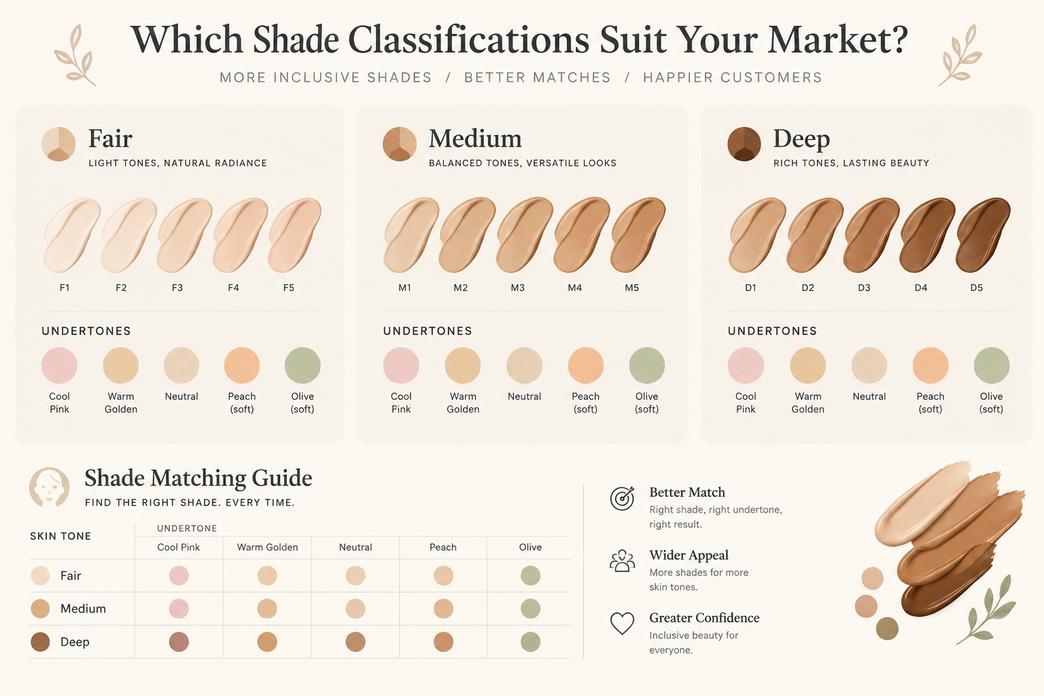
Fair undertone vs. medium complexion vs. dark skin spectrum
A practical skin depth map starts with visible differences, then gets more precise.
- Fair complexion
- Add multiple light complexion tier options rather than one catch-all color.
- Check undertones under daylight and indoor lighting.
- Medium skin
- Build smooth shade gradation through tan and mid-depth colors.
- Test across a broad ethnicity spectrum represented in the target market.
- Dark spectrum
- Keep transitions equally detailed at deeper depths.
- Avoid big shade jumps that make it harder to find right shade of foundation.
Cool pink undertone, warm golden hue, neutral balance shade
Depth gets someone close; undertone makes the match click.
- Cool pink suits skin showing rosy or reddish cues.
- Warm golden uses yellow-gold color pigment for warmer complexions.
- Neutral balance sits between obvious cool and warm cues.
Because skin chemistry and lighting can shift appearance, swatching several neighboring points on the hue spectrum is a smart way to find the right foundation shade.
Peach base pigment and olive cast spectrum explained
- Peach base
- Blends pink and orange warmth within the undertone spectrum.
- Useful color correction can keep a complexion from looking flat.
- Olive cast
- Carries green-yellow skin nuance that standard warm shades may miss.
- Careful pigment formulation preserves chromatic balance instead of turning orange.
Those distinctions help shoppers find right shade of foundation when simple warm, cool, and neutral labels fall short.
Matching deep melanin range with powder compact medium
Deep shades need color depth without a gray or chalky cast. A powder compact should pair its pigment load with the intended coverage type and medium finish.
For a broad melanin range, test both shade depth and undertone on skin. Adjusting formulation density can improve payoff without making powder look heavy, while close shade matching keeps deep complexions lively and natural.
3 Key Factors To Find Right Shade Of Foundation
Trying to find right shade of foundation gets easier when shade choice goes beyond a quick wrist swatch. Formula, production control, and product claims can all affect what finally shows up on your face. For a foundation match that looks spot-on, consider how pigments behave during wear, how batches stay consistent, and how the product suits your skin day to day.
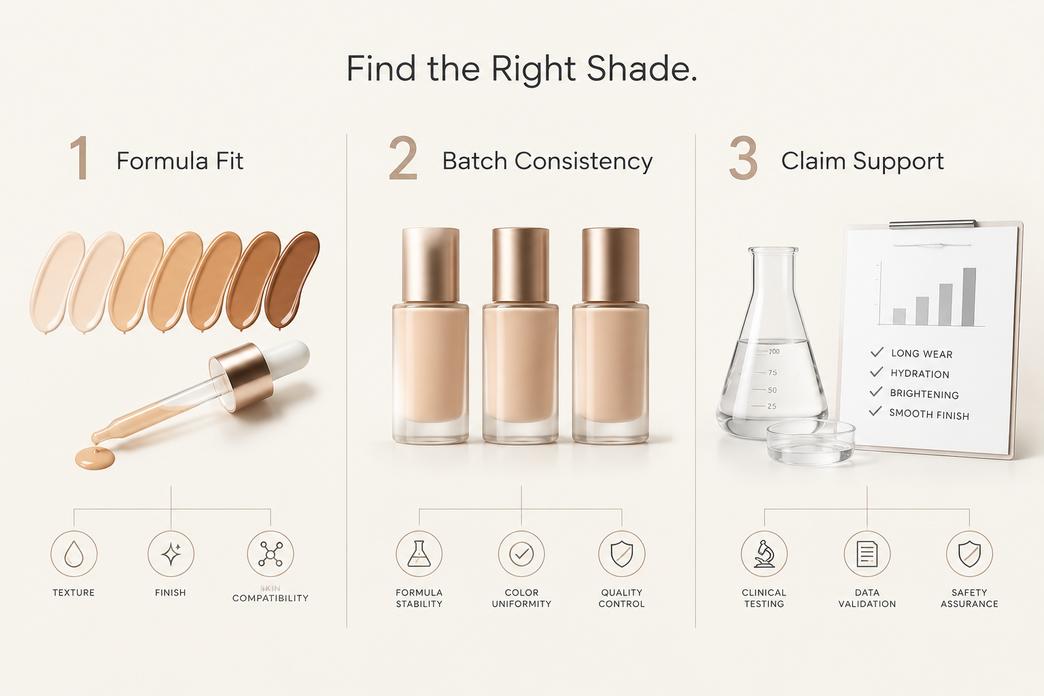
Formulation Attributes: selecting between liquid foundation base and matte finish formula
- Match the formula to your needs:
- Skin type
- Dry skin often benefits from a flexible liquid foundation with a comfortable texture.
- Oily skin may pair better with a matte finish, especially in humid weather.
- Coverage level
- Check the base formula in natural light. Higher coverage can make a slight shade mismatch easier to notice.
- Good pigment dispersion helps color appear even rather than patchy.
- Skin type
The goal is to find right shade of foundation after the formula settles, not just when freshly applied.
Manufacturing Specifications: viscosity testing protocol for consistent color pay-off
- Control formula flow:
- Viscosity testing measures how easily the fluid moves.
- Rheology tracks changes in flow during mixing and application.
- Control pigment behavior:
- A stable pigment load supports reliable color pay-off.
- Routine quality control checks batch consistency against the approved manufacturing specification.
Topfeel Beauty can align formula flow and pigment handling with coverage. See the Great Britain cosmetics guidance.
Regulatory Standards: dermatologist tested claim and non comedogenic rating
- Support product positioning with evidence:
- Dermatologist tested
- Keep study methods and results available to support the claim.
- Include suitable skin tolerance and safety assessment data.
- Non-comedogenic
- Substantiate claims under applicable regulatory standards and local compliance rules.
- Treat hypoallergenic as a separate claim requiring appropriate support.
- Dermatologist tested
These checks support a product that fits skin needs. Claim language should follow the FDA cosmetics labeling guide.
Fewer shade surprises: A usable shade range needs depth, undertone, formula behavior, and stability to agree. Topfeel Beauty’s liquid foundation route supports a brief for coverage, texture, and color payoff.
Use the face-makeup manufacturing page to compare the specification points that need approval before a bulk run.
Undertone Confusion? Simplify Color Matching Now
Finding a foundation match gets easier when undertone, surface color, and product stability are checked together. Small color differences matter. Topfeel Beauty connects shade development with controlled testing.
Identifying your customer’s natural olive cast spectrum
Start complexion mapping in controlled daylight-style lighting; otherwise, a slightly green cast can look oddly yellow.
- Customer assessment
- Check the olive undertone across the jaw, neck, and upper chest.
- Compare green, yellow, and neutral points across the skin spectrum.
- Product planning
- Use chromatic analysis to document pigment variation rather than relying on a quick eyeball check.
- A dermascope can support close surface assessment, while careful neutralization helps refine shades.
This makes it easier to find the right foundation shade without chasing surface redness. For ingredient safety context, consult CIR reports.
Quick guide: peach base pigment versus warm golden hue
A peach pigment mixes pink-orange warmth, while a golden hue pushes toward yellow-gold. Both may suit a warm undertone, but they are not interchangeable.
- Check the color wheel relationship against the customer’s visible undertone.
- Compare hue saturation at equal foundation depth; peach can read rosier as saturation rises.
- Test practical color correction along the jaw and inspect the broader tint spectrum.
That quick comparison helps customers find right shade of foundation instead of choosing by depth alone. European positioning should consider the EU cosmetics regulation.
Streamlining stability test standard for uniform undertone batches
Topfeel Beauty can pair visual checks with measured controls to keep undertones consistent.
- Set the testing framework.
- Define a formulation standard and controlled stability test conditions for temperature, light, and storage.
- Record initial readings with a colorimeter.
- Monitor production.
- Check pigment dispersion before filling.
- Compare samples for batch consistency through scheduled quality control checks.
- Confirm aging performance.
- Track shade drift across expected shelf life.
- Review any yellow, red, or green shift before release.
Stable color makes finding the right foundation match far less of a guessing game.
Warm Vs. Cool
Finding a foundation that melts into your complexion starts with knowing which colors already live in your skin. To find right shade of foundation, look beyond light or deep and check warm versus cool cues. That small distinction can help the right shade of foundation look natural in daylight, not just under store lights.
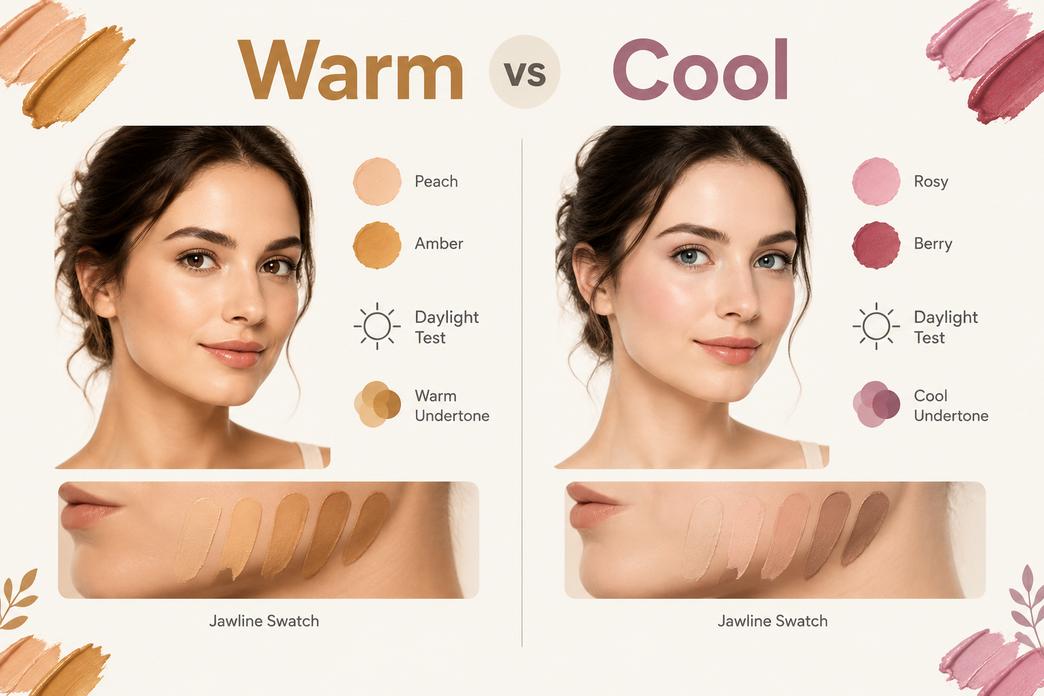
Warm golden hue
Warm complexions usually show yellow, golden, or softly peach notes. To find right shade of foundation, compare those traits rather than choosing a shade simply because its depth looks close.
- Start with the skin’s visible warmth.
- Look around the jaw and neck.
- A clear yellow pigment often points toward golden foundation.
- An olive undertone may look warm yet slightly green, so overly orange shades can feel off.
- Consider how warmth changes with sun exposure.
- A sun-kissed complexion may suit an amber tint.
- Deeper bronze skin tone needs rich warmth without turning red.
- Look around the jaw and neck.
- Test the match in real life.
- Swipe a few shades along the jaw.
- Give each one a moment to settle.
- Pick the shade that seems to disappear.
- Check any uneven areas.
- A peach corrector can handle dark discoloration separately instead of forcing foundation to do all the work.
- Swipe a few shades along the jaw.
Topfeel Beauty can develop warm options across several depths, making it easier to find the right foundation shade without lumping every golden complexion into one color family. Health Canada’s cosmetics guidance provides another market reference.
Cool pink undertone
Cool skin tends to carry pink, rosy, or red notes rather than obvious gold. The trick is keeping that natural coolness balanced instead of covering it with yellow.
Try the jawline: A rosy complexion usually looks more at home beside pink-leaning foundation. Very fair porcelain skin can also reveal cool tones quickly in daylight.
Watch the color mix: Small amounts of blue pigment can support cooler shade development, while a subtle berry tint can suit deeper cool complexions. These choices also help with ashy prevention, especially when richer skin needs both correct depth and undertone.
For visible flushing, treat redness neutralization as a separate concern where needed. Then find right shade of foundation by matching untreated skin around the jaw and neck. That approach makes finding your foundation shade much less of a guessing game.
Move from swatches to specs: A usable range needs shade depth, undertone logic, formula behavior, claims support, and batch checks to agree. Topfeel Beauty states that custom formulations can include compatibility, stability, and safety assessments.
Send your foundation brief to discuss the shade map, formula format, packaging route, and evidence needed for the next sample round.
References
- Cosmetics and Labeling — fda.gov
- Cosmetics and Labeling — fda.gov
- ISO 22716 GMP — iso.org
- EU Cosmetics Regulation — eur-lex.europa.eu
- Cosmetic Ingredient Review — cir-reports.cir-safety.org
- Cosmetics Guidance — canada.ca
- Great Britain Cosmetics Guidance — gov.uk
- Cosmetics Research — pubmed.ncbi.nlm.nih.gov
- Cosmetics and Labeling — fda.gov
Post time: Sep-21-2026