
Private Label Face Mist: Key Considerations for Beauty Brands
A face spray after makeup can fail when formula and nozzle decisions are made separately. For beauty brands, stability and packaging need to be planned together.
Smart sourcing comes down to formula stability, compatibility, manufacturing controls, and documentation.
Key Points: Face Spray After Makeup
➔ Mist Base Selection: Choose hydrating, oil-control, dewy or emulsion formulas—optimize actives and homogenization for stability.
➔ Essential Actives: Incorporate hyaluronic acid, niacinamide, vitamin C, film-forming polymers and botanical barriers for hydration, sebum control, fixation and pollution defense.
➔ pH & Preservation: Maintain optimal pH via QA testing and vacuum homogenization; use broad-spectrum preservatives, ISO 22716 practices and sterile filling.
➔ Packaging & Nozzle: Balance custom vs. standard sprayers: test droplet size, spray angle and compatibility to prevent clogging and separation.
Types Of Mist Bases For Face Spray After Makeup
Choosing a base for face spray after makeup affects comfort, finish, and wear. A hydrating spray feels different from a matte or milky formula. Compare hydration ideas and skin-type guidance.
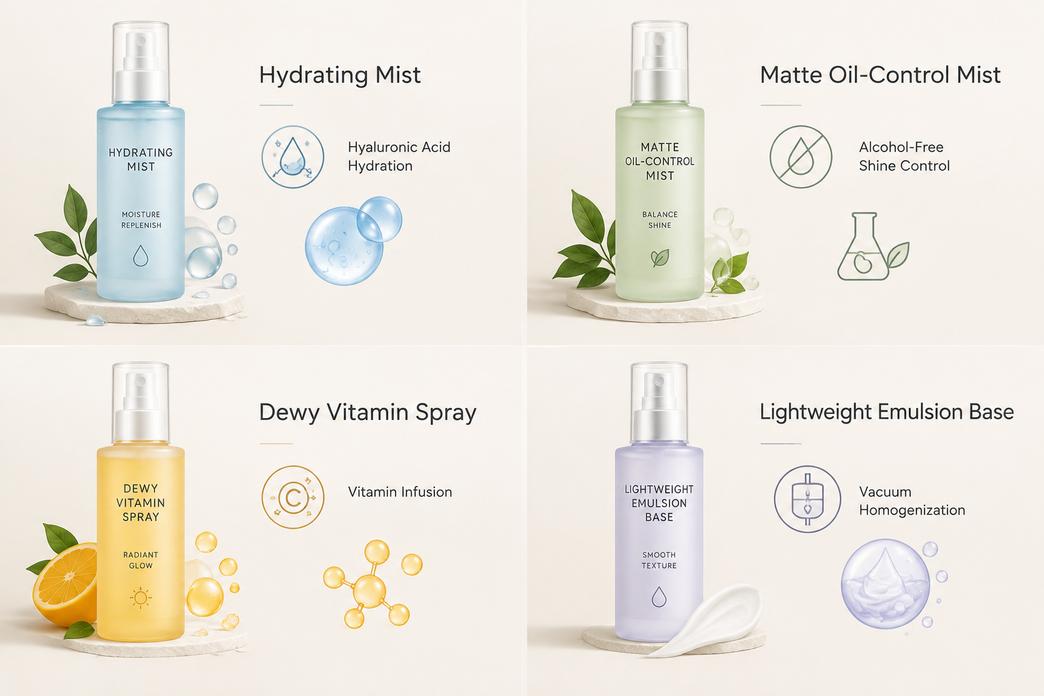
Hydrating Setting Mist with Hyaluronic Acid
Hyaluronic acid works as a humectant, supporting moisture retention and skin hydration. A dermatology overview of moisturizers can help frame the hydration discussion.
- For a hydrating face spray after makeup, compare this hydration guide:
- lower viscosity helps the facial mist spray evenly;
- a compatible setting polymer supports fixation;
- balanced HA levels can deliver a soft finish without sticky buildup.
Oil-Control Veil: Alcohol-Free Formula
An alcohol-free base can tackle shine without a dry, tight feel. Start with skin-type guidance.
- Key performance goals include:Fine particles may add subtle pore blurring, making the mattifying mist practical for oily skin.
- Oil control from a suitable sebum absorber.
- Shine reduction with a clean matte finish.
Dewy Finish Spray as a Vitamin-Infused Toner
A vitamin infusion turns a skin toner into a refreshing facial spray with extra skin-care appeal. Antioxidant ingredients need stability checks because light and oxygen can reduce performance. See the FDA cosmetics overview when defining the product category.
A balanced mist adds radiance and a dewy finish. See the EU claims criteria.
Lightweight Emulsion Base via Vacuum Homogenization
Vacuum homogenization helps Topfeel Beauty build an emulsion base with controlled micro-droplets.
- Manufacturing targets:
- particle size reduction → smoother spray;
- less trapped air → more stable formulation;
- controlled emulsification → cleaner lightweight texture for modern cosmetic manufacturing.
5 Ingredients Every Private Label Face Mist Needs
A strong face mist has to do more than feel fresh. Hydration, oil balance, makeup hold, and pollution support all need to fit the same spray system. See clean beauty guidance when setting ingredient preferences, and review cosmetic ingredient trends before finalizing the brief.
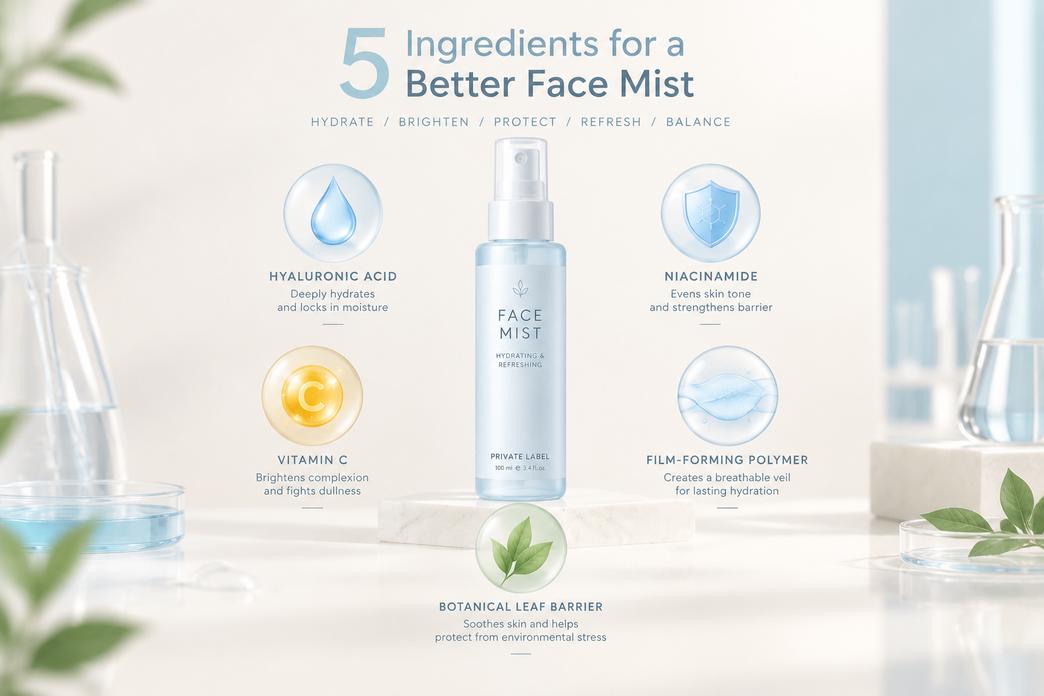
Hyaluronic Acid for Deep Hydration
- Hyaluronic acid helps the mist hold water at the skin surface. Ingredient screening can reference CIR safety reports.
- Molecular weight: affects skin feel and hydration behavior.
- Purity and solubility: support a clear, smooth mist.
- Use level should match the full formula to avoid a sticky finish.
Niacinamide Blend for Sebum Reduction
A well-balanced niacinamide blend supports the skin barrier and helps manage excess sebum. In an after-makeup mist, concentration matters; pH and complete-formula testing keep the oil-control claim grounded.
Vitamin C Antioxidant Extracts
- Stable vitamin C derivatives can add brightening and antioxidant benefits. Claims should be reviewed against the FDA cosmetics labeling guide.
- Check oxidation and color change. A related PubMed review illustrates why ingredient and exposure conditions matter.
- Test supporting antioxidant extracts.
- Confirm bottle compatibility and shelf-life stability.
Botanical Barrier Agents for Pollution Shield
- Selected botanical extracts can support pollution-shield positioning.
- Favor standardized raw materials with consistent active levels.
- Pair protective claims with suitable evidence.
- Confirm antioxidant activity and formula stability before launch.
Precise pH Control In Face Spray After Makeup
A well-made face spray after makeup needs more than a skin-friendly pH on production day. Acidity must stay controlled through filling, storage, and shelf life. For brands developing a makeup face spray, Topfeel Beauty pairs controlled manufacturing with documented testing, helping each mist stay consistent from batch to batch.
Optimal pH Range: Quality Assurance Testing
The target range should come from the finished formula rather than a one-size-fits-all number.
- Quality teams establish the validated pH specification.
- A calibrated pH meter provides repeatable acidity measurement.
- Testing considers acid-base equilibrium after the formula settles.
- Results are checked against practical product needs.A defined quality control protocol catches drift during stability testing, which is key for a dependable makeup spray.
- Skin barrier compatibility matters for a face spray after makeup.
- Preservative performance and cosmetic formulation safety also shape acceptable limits.
Vacuum Homogenization for Consistent Acidity
Topfeel Beauty can use a vacuum emulsifying mixer when the formula calls for controlled mixing and air removal.
- Blending applies suitable shear stress, supporting particle size reduction and even ingredient distribution.
- The degassing process removes trapped air while mixing promotes chemical homogeneity.
- After cooling, technicians recheck pH because temperature and ingredient interactions can affect formulation stability.
That routine helps a face mist stay consistent instead of leaving tiny pockets with different acidity.
ISO 22716 Certification and pH Documentation
pH control also needs a paper trail.
- ISO 22716-aligned Good Manufacturing Practices establish controlled testing procedures.
- Each batch record can capture:
- pH specification and result
- test method and equipment
- deviations and approved corrective action
- This documentation supports:
- traceability for private-label production
- audit documentation during quality reviews
- regulatory compliance and alignment with the applicable cosmetic standard
- Each batch record can capture:
Topfeel Beauty connects these records with production controls so acidity results can be traced rather than simply assumed. The ISO 22716 GMP guidance provides a useful manufacturing framework. A qualified manufacturer checklist can help organize the supplier review.
A steadier mist brief: Formula base, active load, pH specification, homogenization, spray behavior, and batch records need to be judged together. Topfeel Beauty’s custom-solutions process gives a brand a practical route to compare samples, packaging fit, and stability decisions before committing to a production brief.
See the face-makeup manufacturing route to decide which formula and finish should move into sampling.
Custom Nozzle Vs. Standard Sprayer—Which To Choose?
Choosing hardware for face spray after makeup comes down to how the formula, user experience, and budget fit together. A custom head offers tighter control over the mist, while standard hardware keeps sourcing pretty straightforward. For any makeup face spray, lab testing matters: viscosity, dose, sealing, and container fit can quickly turn a good-looking concept into a practical package.
Custom Nozzle Design
A custom nozzle gives face spray after makeup more room for tuning. Small changes can shape comfort and coverage.
- Spray performance
- Orifice size controls liquid flow and helps set droplet behavior.
- A wider or smaller opening should be tested with actual formula viscosity.
- Spray pattern and fine mist quality affect how evenly makeup spray lands.
- Orifice size controls liquid flow and helps set droplet behavior.
- User and brand fit
- An ergonomic actuator can make repeated pumping feel easier.
- A proprietary mold adds brand differentiation and aesthetic appeal, though tooling adds cost and development time.
For face spray after makeup, prototypes should be tested rather than judged by appearance alone.
Standard Sprayer Mechanism
A stock component can be the simpler call when cost efficiency and shorter lead time matter. Its pump engine and dip tube still need formula-specific checks; so-called universal compatibility does not guarantee trouble-free performance.
| Test | Trial A | Trial B |
|---|---|---|
| Dose per stroke (mL) | 0.12 | 0.15 |
| Spray distance (cm) | 15 | 20 |
| Test cycles (pumps) | 500 | 1,000 |
These are practical test settings, not universal specifications. Check for clogging, dose variation, container fit, and leak resistance. That basic homework can save a lot of hassle later. Packaging claims should also fit the EU cosmetics regulation where relevant.
Better package decisions: A nozzle is part of the product experience, so dose, spray pattern, sealing, and formula viscosity should be reviewed as one package. Topfeel Beauty documents packaging support from stock components to custom molds with compatibility checks.
Review the customization workflow to compare standard and custom hardware, then use the face-makeup route to prepare a complete sprayer checklist.
Face Spray After Makeup Preservation Systems Explained
A water-based mist needs preservation, clean filling, safety records, and stability checks.
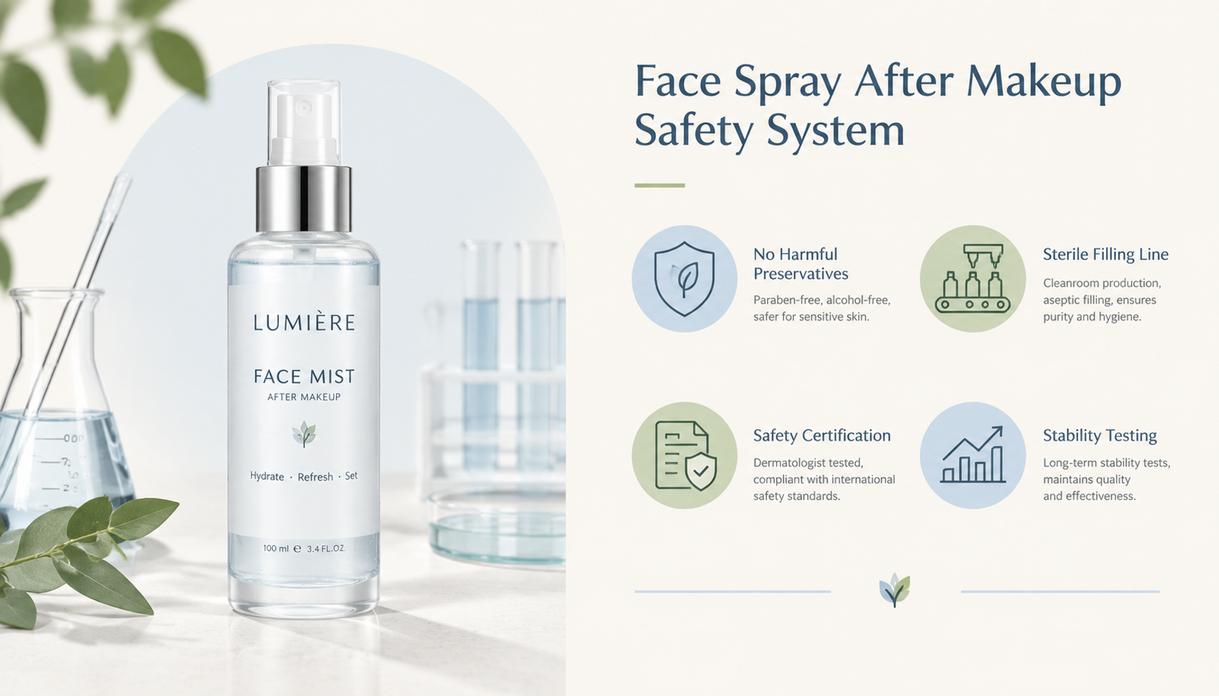
Broad-Spectrum Preservative Blend
- Preservation starts with a cosmetic grade system suited to the formula.
- Phenoxyethanol may support broad antimicrobial efficacy, including in some paraben-free products.
- pH range stability and formulation compatibility need checking.
- Microbial challenge testing confirms performance rather than relying on guesswork.
Sterile Filling Line Best Practices
Clean filling keeps a makeup mist safer after batching. Aseptic processing practices combine equipment sterilization, strong operator hygiene, and suitable cleanroom standards. HEPA filtration and routine environmental monitoring also help spot microbial contamination before it becomes a bigger headache. Health Canada’s cosmetics safety guidance is another market reference.
MSDS Documentation for Ingredient Safety
- Each applicable raw material should have a current material safety data sheet.
- Teams can review:
- chemical composition and hazardous components
- toxicological data and first aid measures
- handling and storage details tied to regulatory compliance
- Teams can review:
That paperwork makes face spray after makeup production easier to manage day to day.
GMP Auditing Report on Shelf-Life Stability
A makeup setting mist needs evidence behind its shelf-life claim. Good manufacturing practices support traceability through each batch record, while an accelerated aging test helps track product degradation.
- Quality assurance reviews stability results.
- Findings support suitable expiration dating and ongoing product control.
Launch with evidence: Preservation, clean filling, MSDS records, and shelf-life checks should form one release decision. Topfeel Beauty states that samples take about 7 days and mass production about 45 days after approval. Topfeel Beauty states that its GMPC and ISO 22716-certified manufacturing can provide MSDS and COA documentation for formulations.
Submit your requirements to discuss the preservation system, testing package, and production route for your face mist.
References
- Cosmetics and Labeling — fda.gov
- Cosmetics and Labeling — fda.gov
- ISO 22716 GMP — iso.org
- EU Cosmetics Regulation — eur-lex.europa.eu
- EU Cosmetics Regulation — eur-lex.europa.eu
- Cosmetic Ingredient Review — cir-reports.cir-safety.org
- Cosmetics Guidance — canada.ca
- Dermatology Skin Care Guide — aad.org
- Cosmetics Research — pubmed.ncbi.nlm.nih.gov
Post time: Sep-14-2026