
Private Label Eye Makeup Tools: A Buyer’s Checklist
One bad batch can turn a beauty launch into a costly headache. Sourcing private label eye makeup tools means balancing quality, branding, and wholesale costs.
From eyeshadow brushes to eyelash curlers, details matter. This checklist covers materials, inspections, customization, and bulk ordering.
Key Points: Eye Makeup Tools Essentials
➔ Quality Control: Define bristle retention, corrosion inspections, and sanitation requirements for the product and market.
➔ Material Selection: Specify fibers, metal grades, and silicone components rather than relying on broad material labels.
➔ Customization Options: Compare grip design, logo application, and packaging against approved samples.
➔ Supply Chain Efficiency: Agree on cartons, pallet arrangements, freight responsibilities, and customs documentation.
Why Choose Private Label Eye Tools?
Private label accessories help brands build recognizable ranges. When assessing a manufacturing partner, separate confirmed capabilities from proposed development work. Topfeel Beauty’s business scope includes cosmetics tools and gift sets.
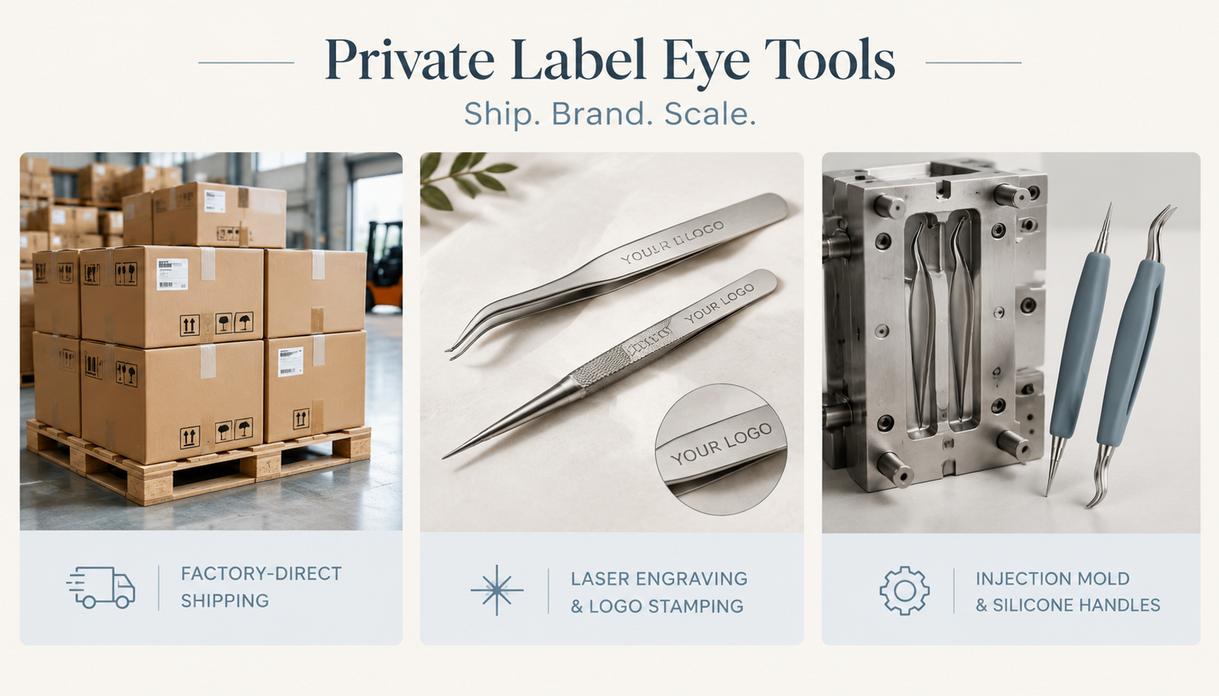
Factory Direct Shipping: Leveraging Bulk Freight Efficiencies
Plan bulk shipping around product protection and handling needs. An agreed Incoterms rule allocates delivery obligations, costs, and risks between buyer and seller.
Key shipping considerations include:
- Packaging and cargo planning
- Master cartons: Approve carton dimensions and protective inserts.
- Pallet packaging: Confirm stacking and handling arrangements.
- Shipping and delivery coordination
- Freight forwarding: Assign transport and customs-paperwork responsibilities.
- Warehouse distribution: Agree receiving and replenishment arrangements.
Topfeel Beauty offers EXW, FOB, CIF, and DDP terms; confirm the chosen term in the quotation.
Custom Logo Stamping for Stand-Out Brand Identity
Customization turns a generic accessory into a branded product. Compare logo methods on the actual component before approval.
Different surface finishing methods require sample review:
- Laser engraving: Check mark clarity on the proposed metal.
- Pad printing: Assess coverage on curved surfaces.
- Embossing technique: Review relief and legibility on packaging.
Thoughtful product packaging connects the tool to its visual identity. Evaluate pouches, paper boxes, and displays against your brief.
For growing brands, approve artwork and finished samples together.
Injection Molding Partnerships to Accelerate Production
Define consistent quality requirements in a clear custom-component specification. Include tooling choices in the development brief.
- Product development
- Tooling design: Specify grip and handle geometry.
- Polymer processing: Agree material and processing requirements.
- Manufacturing efficiency
- Industrial machinery: Confirm the proposed production process.
- Component assembly: Check fitting and finishing on samples.
- Production reliability
- Quality control: Document dimensions, appearance, and function.
- Production timeline: Approve milestones before ordering.
Topfeel Beauty’s packaging support includes custom mold development and 3D prototyping; discuss accessory-component feasibility separately.
One coordinated sourcing brief: Factory direct shipping, custom logo stamping, and injection molding decisions need a shared approval path. Topfeel Beauty’s published customization process connects consultation and sampling with packaging design, production, QC, and delivery, giving buyers a framework for organizing feasibility decisions before committing to a launch.
Review custom solutions to prepare a combined component, artwork, and delivery brief for feasibility review.
What Classifications Fit Your Eye Tools?
Choose tools by application task, construction, and handling preference. Compare brush types and uses before deciding which accessories belong in the range.
Eyeshadow Brush: Synthetic Taklon Fiber & Aluminum Ferrule
For an Eyeshadow Brush, specify Synthetic Taklon Fiber and review samples with the intended formulas. Confirm the basis of any Cruelty-Free Bristles claim.
- Material quality
- Aluminum Ferrule: Inspect crimping and fiber attachment.
- Fiber density: Compare pickup and release on samples.
- Practical performance
- Makeup Applicator: Assess controlled color placement.
- Blending Tool: Compare edge blending with your formula.
Include handle comfort and cleaning instructions in approval criteria.
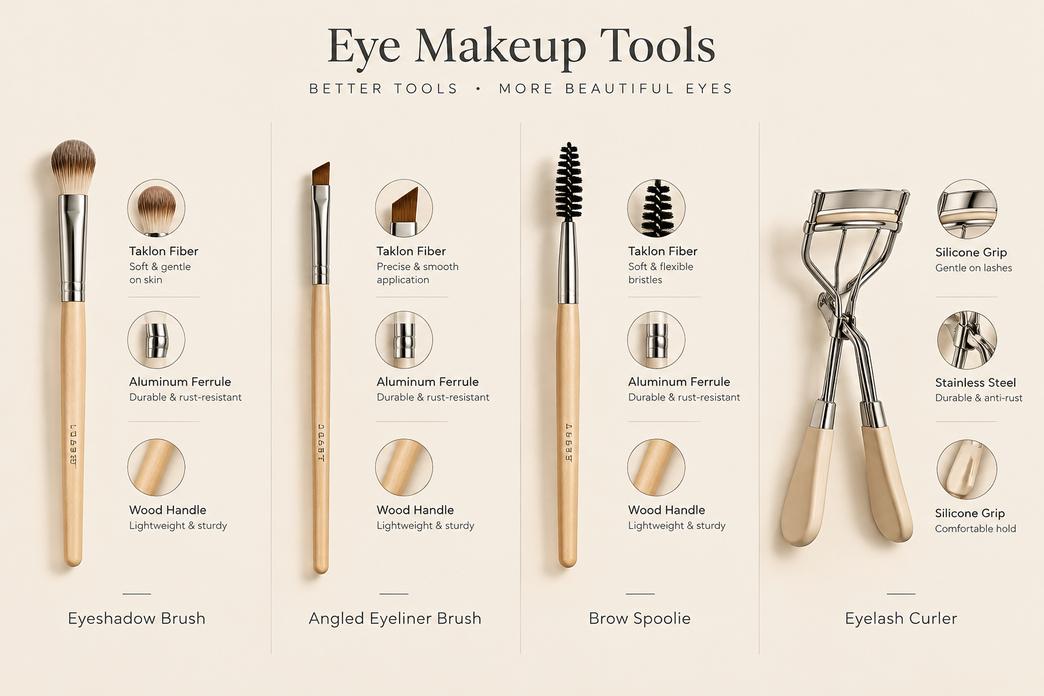
Angled Eyeliner Brush with Wood Handle & Stainless Steel Component
An Angled Eyeliner Brush should suit the intended line width and formula.
Review the angled design for application control alongside your eyeliner application direction.
- Construction: Inspect the Wood Handle and Stainless Steel component for secure assembly.
- Precision: Assess the Precision Liner shape on an application sample.
- Comfort: Check balance during repeated handling.
Include detailed application in your sample review.
Brow Spoolie Featuring Silicone Pad Grip
A Brow Spoolie belongs in a brow-product application plan alongside pencils or powders.
- Comfort features
- Silicone Pad: Evaluate grip with dry and damp hands.
- Ergonomic Grip: Compare handle shape with users.
- Everyday versatility
- Eyebrow Grooming: Assess shaping and product distribution.
- Lash Separator: Confirm whether lash use is intended.
Check this Beauty Implement against its stated purpose.
Eyelash Curler Crafted from Corrosion-Resistant Stainless Steel
A reliable Eyelash Curler needs an application and maintenance brief.
Specify the Stainless Steel grade and finish rather than relying on a general material label.
Key buying considerations include:
- Lash Lifting Tool: Inspect jaw alignment and pressure.
- Eye Enhancement: Check silicone-pad fit and replacement availability.
- Beauty Device: Assess handle travel and spring action.
Document material and assembly requirements before approving accessories.
Build a task-led assortment: Which brushes and grooming accessories actually belong together in your customer’s routine?
Topfeel Beauty’s 5pcs foundation and eyeshadow brush set gives buyers a defined brush-set starting point. Compare that assortment with the broader beauty tools category to prepare a brush, brow, and lash accessory shortlist; confirm each component’s intended use and construction separately.
Top 4 Quality Checks for Eye Tools
Quality checks should match the component and intended use. Define methods, sample quantities, and acceptance criteria before approving an order.
Bristle Pull Test on Synthetic Taklon Fiber Brushes
Review fiber attachment rather than judging only appearance. A brush-retention procedure needs an agreed setup.
Key inspection points include:
- Fiber strength and retention
- Use a pull testing machine with a documented setup.
- Record bristle retention and loose fibers.
- Assembly quality
- Examine adhesive bonding and ferrule assembly.
- Check shedding prevention after repeated brushing.
Request documented results before bulk approval.
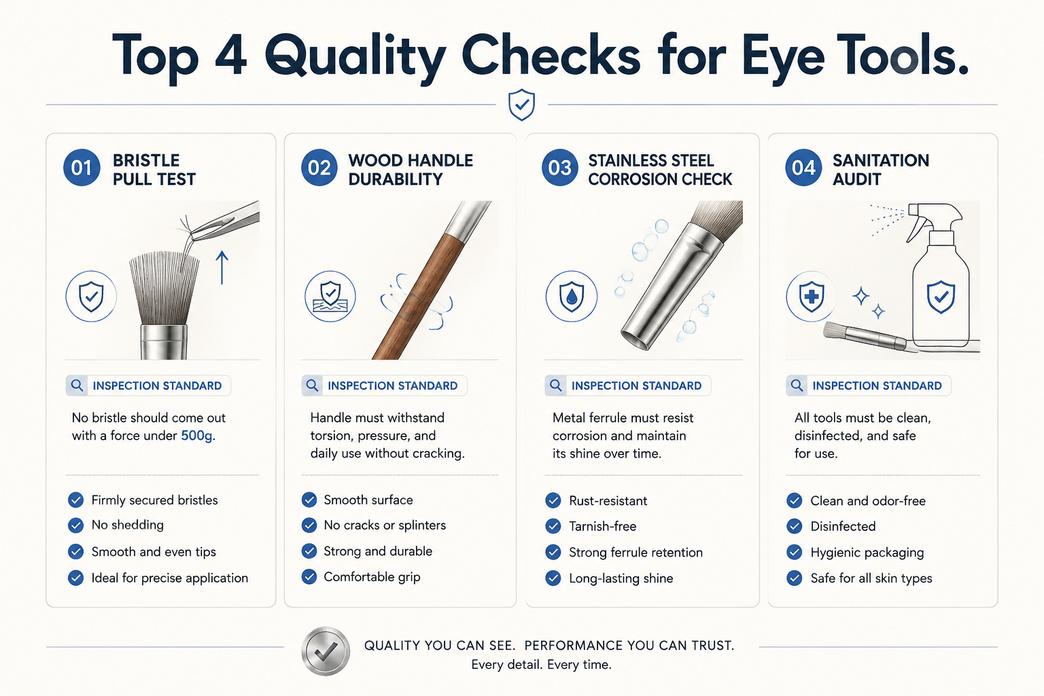
Handle Durability Test for Wood-Handled Implements
Inspect a cracked brush handle and rough edges during sample review.
For wood-handled implements, cover three areas:
- Structural strength
- Test impact resistance using an agreed procedure.
- Examine joint stability around ferrules.
- Environmental protection
- Evaluate moisture tolerance against intended storage conditions.
- Inspect the surface finish after conditioning.
- Daily performance
- Conduct wear testing against agreed handling criteria.
Review whether the wood handle remains smooth, secure, and comfortable.
Corrosion Resistance Inspection of Stainless Steel Curlers
Inspect eyelash curlers for rust and review component records.
Agree which corrosion test, if any, fits the specification.
- Material verification
- Confirm alloy composition and supplier specifications.
- Check metal plating for surface defects.
- Environmental testing
- Conduct a salt spray test under an agreed method; ASTM B117 describes salt-spray apparatus operation.
- Evaluate oxidation resistance against documented criteria.
- Surface protection
- Inspect surface passivation records where specified.
- Verify corrosion protection at hinges and joints.
Keep test conditions with checks for everyday use.
Sanitation Audit and Applicable Material Safety Requirements
Review clean manufacturing practices alongside material records.
A sanitation audit should examine contamination controls and handling procedures.
Buyers should prioritize:
- Material safety: Review specifications and relevant toxicological risk assessments.
- Regulatory checks: Establish requirements for the product and destination market.
- Skin compatibility: Request evidence for any hypoallergenic material claim; FDA has no federal definition or standard for the term on cosmetics.
- Manufacturing controls: Examine cleaning records and quality assurance procedures.
FDA’s eye-cosmetic guidance advises keeping instruments clean and avoiding sharing cosmetics.
Include brush cleaning in the user-care brief; the American Academy of Dermatology recommends washing makeup brushes every 7–10 days.
Silicone vs. Synthetic Eye Makeup Tools
Compare materials with the intended formula and cleaning routine. Beginner brush guidance can help define application tasks before selecting samples.
Silicone Pad Tools
Evaluate silicone applicators for flexibility, residue removal, and handling. Inspect the finished surface rather than assuming performance from the material name.
Consider these features:
- Material Quality and Comfort
- Flexible tip: Check movement around application contours.
- Hygienic surface: Review cleaning instructions and residue.
- Smooth blending: Trial with intended creams and gels.
- Application Performance
- Crease tool: Assess placement around eyelid folds.
- Easy-to-clean design: Check accessible seams.
- Elasticity: Inspect deformation after use.
- Long-Term Value
- Check silicone specifications and safety documentation.
- Confirm replacement pad availability.
- Inspect attachment points after handling.
Compare convenience using the same application task.
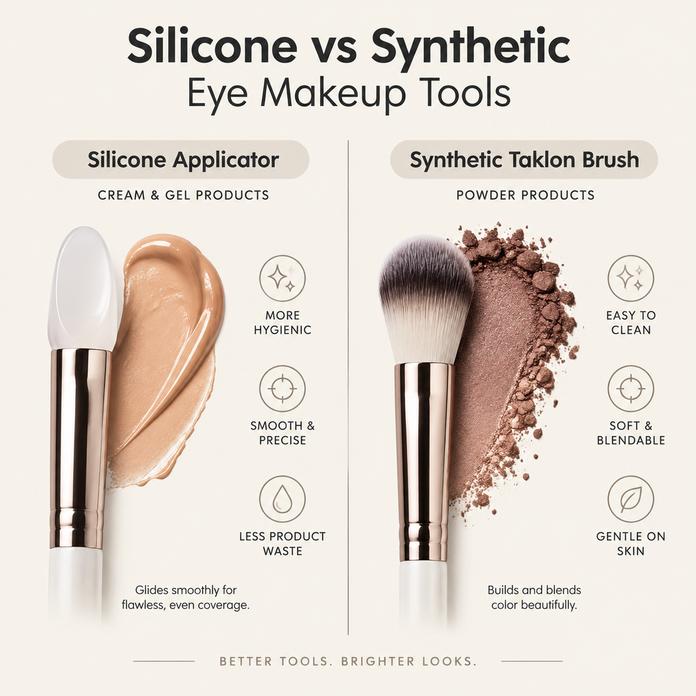
Synthetic Taklon Fiber Brushes
Compare synthetic brushes by head shape and fiber assembly.
Review taklon bristles for texture on approved samples.
Key buying considerations include:
- Precision blending: Compare tapered-head application.
- Powder pickup: Assess pigment collection and release.
- Ergonomic handle: Review grip comfort.
- Cruelty-free: Request supporting claim documentation.
- Cleaning durability: Inspect shape and shedding after washing.
Record changes after repeated cleaning.
Discuss synthetic brush development and acceptance criteria before production.
Ultimately, compare silicone and synthetic designs using the same formula, application task, and maintenance expectations.
Inconsistent Quality? Standardized QC Protocols
Standardized QC begins with documented specifications. When reviewing manufacturers, separate factory-system evidence from product-specific test results.
ISO Certification and Cruelty-Free Manufacturing Claims
ISO 9001 sets requirements for a quality management system; review individual tool performance through product-specific testing.
Check the scope of the supplier’s documentation. ISO 22716 provides cosmetic good manufacturing practice guidelines; evaluate tool-specific requirements separately.
- Factory quality systems
- Quality management: Review process-control responsibilities.
- Manufacturing lines: Confirm inspection procedures.
- Audit standards: Check certificate validity and scope.
- Ethical production checks
- Cruelty-free: Request animal-testing claim documentation.
- Cosmetic tools: Review material sourcing records.
- Compliance verification: Match evidence to the claim.
Review quality-system and ethical claims separately.
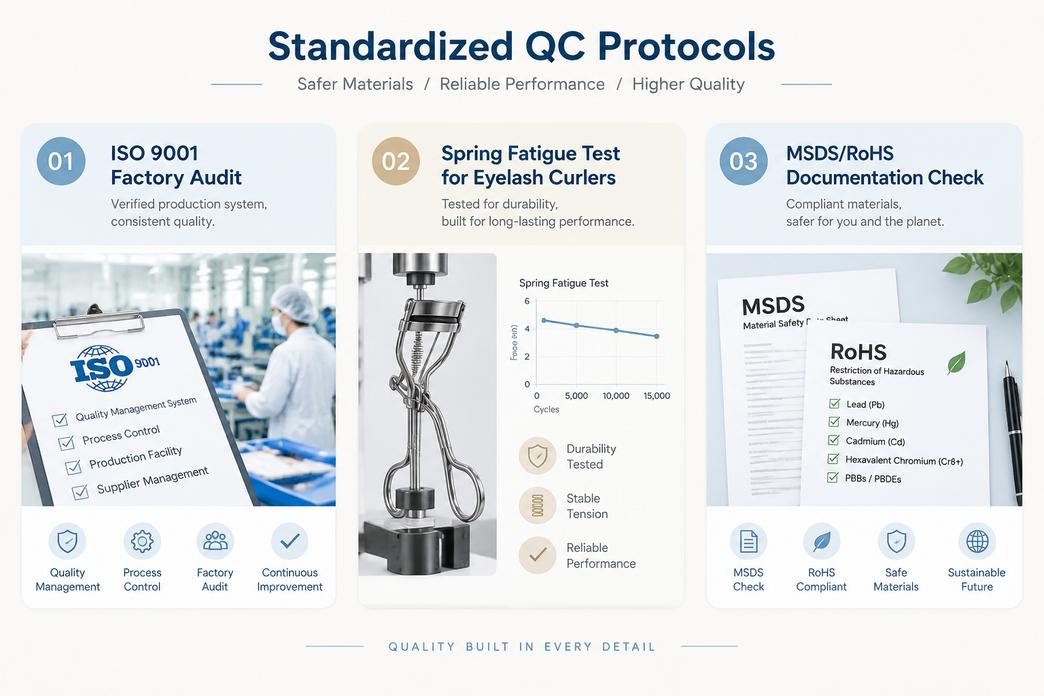
Spring Fatigue Test in Manual Assembly Processes
Assess the curler after repeated operation.
Inspect spring placement during assembly review.
Key inspection activities include:
- Cycle testing: Compress and release under agreed conditions.
- Mechanical stress: Check bending and loose connections.
- Durability testing: Compare results with acceptance limits.
- Quality control: Inspect alignment and movement.
Record changes in spring operation.
Establish testing requirements before bulk production.
MSDS Documentation and RoHS Compliance Audits
Review material safety records alongside mechanical performance requirements.
Buyers should examine three areas:
- MSDS documentation: Request applicable safety data sheets for manufacturing chemicals; they describe hazards and inform workplace risk assessments.
- RoHS compliance: Check applicability first: the directive restricts hazardous substances in electrical and electronic equipment.
- Supplier verification: Review specifications and laboratory reports.
Review relevant REACH obligations with the supplier; the regulation addresses chemical substances, including their use in articles.
Do not assume an ordinary non-electrical accessory needs a RoHS report.
For brands selling internationally, organize documentation by product and destination.
Make QC actionable: Certification scope, spring-cycle criteria, and material documentation need one approval brief. Topfeel Beauty’s published customization process places QC after production and before delivery, providing a clear point to discuss the evidence your accessory order requires.
Contact Topfeel Beauty with that inspection-and-documentation brief to confirm feasible checks and responsibilities before production.
References
- Incoterms rules — iccwbo.org
- Standard Practice for Operating Salt Spray (Fog) Apparatus — astm.org
- Hypoallergenic Cosmetics — fda.gov
- Eye Cosmetic Safety — fda.gov
- How to clean your makeup brushes — aad.org
- ISO 22716:2007 — Cosmetics good manufacturing practices — iso.org
- ISO 9001:2026 — Quality management systems requirements — iso.org
- RoHS Directive — europa.eu
- Understanding REACH — europa.eu
- Safety Data Sheets — hse.gov.uk
Post time: Nov-02-2026