
FDA vs EU Rules for Silica Powder Used in Cosmetics
Cross-border launches stall fast when cosmetic grade silica powder regulatory standards fda eu get brushed off as minor details.
Grand View Research’s 2025 cosmetics ingredients outlook notes stricter EU documentation trends driving supplier shifts, with compliance-led sourcing rising across color and face powders.
That gap hits your timelines and margins, so picking silica backed by audit-ready files isn’t optional, it’s survival.
Key Points for Navigating Cosmetic Grade Silica Powder Regulatory Standards FDA EU
- Align Purity and Particle Size: Ensure silica meets US heavy-metal limits and EU REACH impurity profiles while optimizing soft-focus performance.
- Dual Documentation Ready: Maintain CoA, SDS, and INCI lists for FDA compliance and prepare PIF/CPSR dossiers for the EU.
- Harmonize GMP Protocols: Integrate FDA GMP basics with ISO 22716 controls to guarantee traceability, hygiene, and consistent manufacturing.
- Verify Quality Parameters: Monitor pH, moisture, bulk density, and microbiological purity per both FDA and EU cosmetic regulations.
How 90% Of EU Cosmetics Use Silica Powder
Silica isn’t hype—it’s chemistry doing its quiet job. Across Europe, brands rely on cosmetic grade silica powder regulatory standards fda eu compliance to keep products smooth, safe, and market-ready. From texture tweaks to oil control, silica powder FDA EU alignment shapes modern cosmetic formulation in real, everyday products.
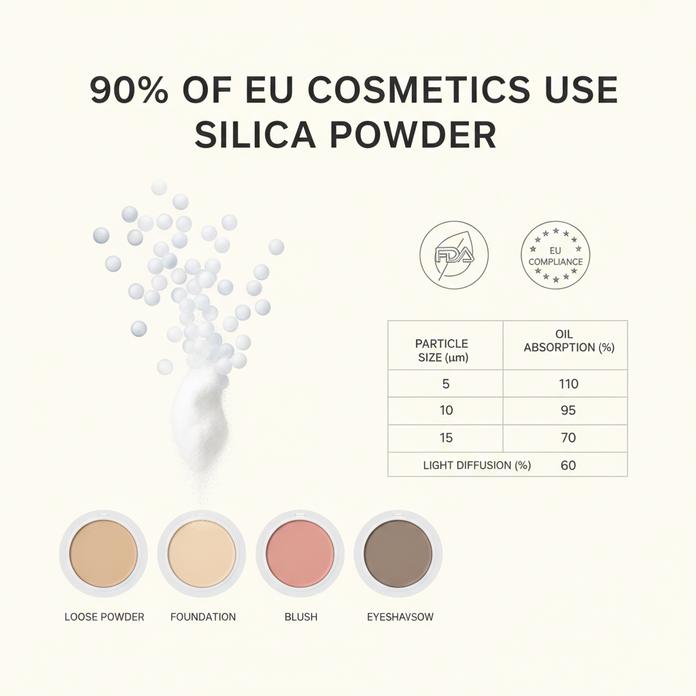
Amorphous Silica’s Role in Loose Powder and Foundation
In loose powder and foundation, amorphous silica works as a high‑performance cosmetic ingredient. It improves texture, boosts absorbency, and supports airtight formulation stability under cosmetic grade silica powder regulatory standards fda eu rules.
- Enhances slip without heaviness
- Prevents caking in humid storage
- Stabilizes pigment dispersion
Performance comparison under cosmetic silica powder regulatory standards:
| Property | 5 µm Avg Size | 10 µm Avg Size | 15 µm Avg Size |
|---|---|---|---|
| Oil Absorption (g/100g) | 110 | 95 | 80 |
| Light Diffusion (%) | 78 | 70 | 60 |
| Flowability Index | 8.5 | 7.2 | 6.1 |
- Raw silica selection aligned with silica powder FDA
- Surface treatment validation
- Stability testing under silica powder EU regulations
Manufacturers like Topfeel integrate cosmetic grade silica FDA EU documentation directly into sourcing workflows, keeping regulatory compliance clean and simple.
Hydrated Silica for Oil Control in Blush and Eyeshadow
Hydrated silica handles serious oil control in blush and eyeshadow formulas. It supports sebum absorption while preserving pigment clarity.
Key mechanisms inside cosmetic formulation under FDA EU cosmetic regulations:
- Surface porosity traps oil
- Micro-structure keeps a matte finish
- Balanced hardness prevents chalkiness
Application logic:
- Base powder blending
- Controlled particle dispersion
- Pressed pan compression testing
Under cosmetic grade silica powder regulatory standards fda eu compliance, hydrated variants must meet purity and heavy metal limits. Topfeel ensures silica powder EU regulations documentation is batch-tracked, which makes audits way less stressful.
Particle Size Distribution: Ensuring Soft Focus Effects
The magic lives in particle size distribution. Controlled sizing shapes optical properties, influencing light scattering and the visible soft focus effect.
Hierarchy inside cosmetic science:
-
Optical Layer
- 1–5 µm: high diffusion, pore blurring
- 6–12 µm: balanced glow control
-
Sensory Layer
- Fine particles: silky feel
- Medium particles: cushion texture
-
Regulatory Layer
- Compliance with cosmetic grade silica powder regulatory standards fda eu
- Alignment with silica powder FDA and silica powder EU regulations
✓ Smaller particles = stronger blur
✓ Wider distribution = smoother blend
✓ Tight specs = easier FDA EU cosmetic regulations approval
When cosmetic grade silica powder regulatory standards fda eu are met, the finish looks effortless—soft skin, muted shine, zero flashback. And that’s exactly why silica powder FDA EU compliance keeps showing up in 90% of EU cosmetic labels.
4 Key Differences: FDA Vs EU Silica Rules
Understanding cosmetic grade silica powder regulatory standards fda eu can feel like decoding two rulebooks at once. Let’s break it down clearly, so compliance doesn’t turn into a guessing game.
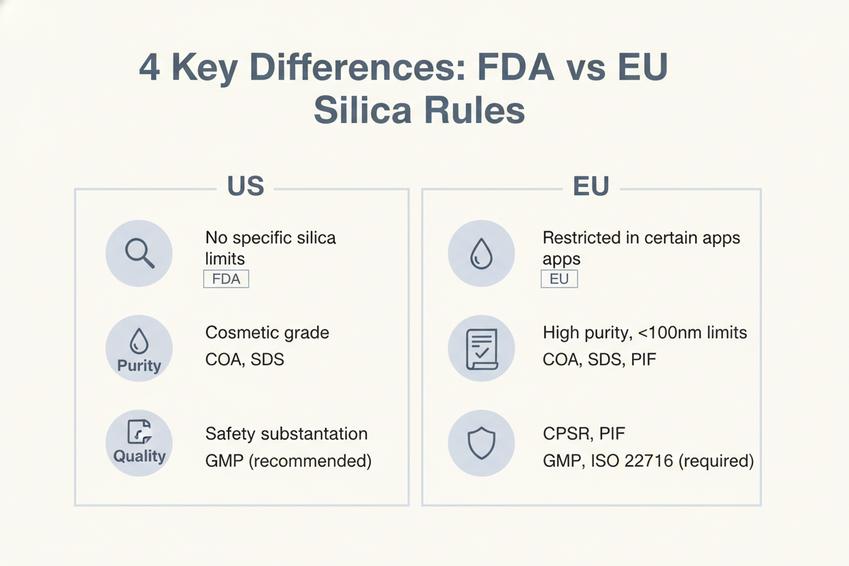
Regulatory Coverage: FDA Cosmetics Regulations vs EU Cosmetics Regulation
When reviewing cosmetic grade silica powder regulatory standards fda eu, start with legal scope.
- FDA oversees cosmetics under the Federal Food, Drug, and Cosmetic Act.
- The EU applies Regulation (EC) No 1223/2009 across member states.
- Both demand compliance, yet enforcement style differs.
In the U.S., regulations focus on post-market control. No formal pre-approval for most cosmetics. In Europe, legislation requires pre-market safety validation and a Responsible Person inside the EU.
Key contrasts:
-
Registration:
- US: Voluntary facility registration.
- EU: Mandatory CPNP notification.
-
Safety Review:
- US: Manufacturer responsibility.
- EU: Formal safety assessment required.
-
Market Control:
- US: Reactive enforcement.
- EU: Structured documentation review.
If you’re aligning with cosmetic grade silica powder regulatory standards fda eu, the EU side simply asks for more paperwork upfront.
Purity Standards: US Heavy Metal Limits vs REACH Classification
Under cosmetic grade silica powder regulatory standards fda eu, purity means different checkpoints.
- US guidance stresses heavy metals and contaminant limits.
- The EU integrates REACH, requiring substance classification and impurity profiling.
Comparative Overview
| Criteria | US Focus | EU Focus | Regulatory Trigger |
|---|---|---|---|
| Heavy Metals | Lead, arsenic ppm guidance | Controlled via REACH Annexes | Safety risk level |
| Impurities | General safety review | Detailed impurity disclosure | Hazard classification |
| Substance Status | No pre-market listing | REACH registration if applicable | Tonnage thresholds |
| Risk Model | Manufacturer-based | Formal risk assessment | Exposure calculation |
So when people say silica is “just inert,” regulators still expect proof. Safety standards aren’t casual suggestions.
Documentation Requirements: CoA & SDS in the US vs PIF & CPSR in Europe
For cosmetic grade silica powder regulatory standards fda eu, documentation is where differences really show.
US side essentials:
- CoA confirming purity specs
- SDS outlining hazard communication
- Internal safety files
EU requirements stack deeper:
-
PIF (Product Information File)
- Administrative data
- Manufacturing method
- Proof of claimed effects
-
CPSR (Cosmetic Product Safety Report)
- Toxicological profile
- Exposure assessment
- Margin of safety calculation
Short version? The EU expects a fully traceable safety story. The US expects proof on file if asked.
Quality Protocols: GMP & ISO 22716 Alignment Differences
Quality protocols tie everything together in cosmetic grade silica powder regulatory standards fda eu.
US expectations:
- Follow GMP principles.
- Maintain batch records.
- Prevent contamination.
EU expectations go further:
-
Mandatory alignment with ISO 22716
- Documented procedures
- Personnel training logs
- Traceability systems
- Audit-ready certification
The gap isn’t about product chemistry; it’s about process discipline.
For brands sourcing silica globally, partners like Topfeel often align operations with both GMP and ISO 22716 to simplify dual-market entry. That approach saves time, reduces compliance friction, and keeps your cosmetics line moving without regulatory headaches.
Can You Meet Both FDA And EU Criteria?
Selling under cosmetic grade silica powder regulatory standards fda eu isn’t just paperwork—it’s chemistry, data, and daily factory discipline. Brands chasing both markets must align purity, safety, and documentation without cutting corners. Here’s how smart manufacturers balance U.S. FDA rules and EU compliance while keeping products market-ready.
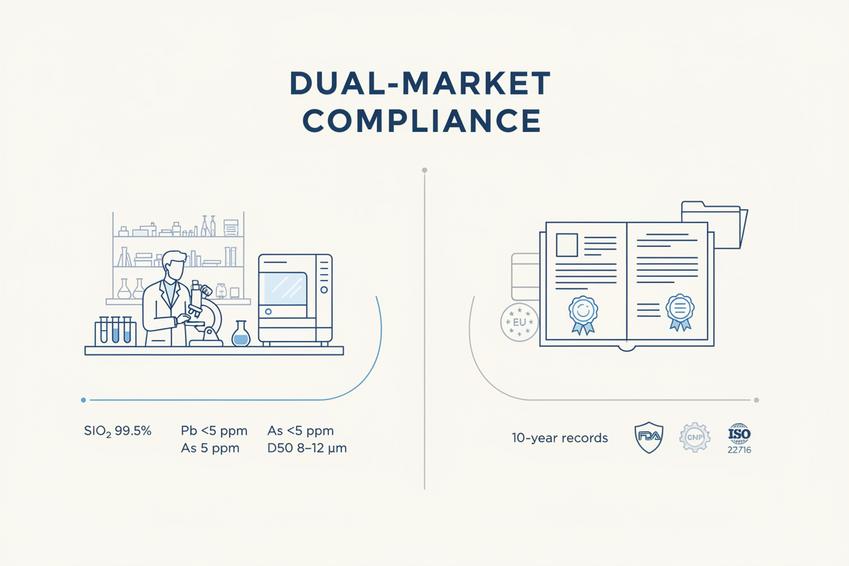
Harmonizing Purity Standards and Particle Size Distribution
Meeting cosmetic grade silica powder regulatory standards fda eu starts with aligning Purity, Standards, and Particle size Distribution across jurisdictions.
- Purity benchmarks typically exceed 99.0% SiO₂.
- Heavy metal Contaminants must meet strict ppm thresholds.
- Verified Assay methods ensure batch consistency.
- Define dual-market Specifications
- Validate analytical methods
- Confirm Regulatory compliance through third-party labs
★ Safety margins must satisfy the stricter authority.
Manufacturers aligning FDA and EU cosmetic rules often structure control like this:
-
Raw Material Qualification
-
Supplier audit
- Heavy metal screening (Pb, As, Cd, Hg)
- Crystalline silica confirmation (<1%)
-
Incoming batch verification
-
-
Particle Engineering
- Control of median Particle size (e.g., D50 5–15 µm)
- Narrow Distribution range
-
Finished Product Testing
- Stability under heat/humidity
- Microbiological review
| Parameter | FDA Expectation | EU Expectation | Typical Target | Test Method |
|---|---|---|---|---|
| SiO₂ Assay | ≥99% | ≥99% | 99.5% | XRF |
| Pb (ppm) | <10 | <10 | <5 | ICP-MS |
| As (ppm) | <3 | <3 | <1 | ICP-MS |
| Crystalline Silica | Controlled | Strictly limited | <1% | XRD |
| D50 (µm) | Declared | Declared | 8–12 | Laser Diffraction |
The phrase cosmetic grade silica powder regulatory standards fda eu becomes practical when lab numbers line up cleanly on both sides of the Atlantic.
Integrating GMP, ISO 22716, and Good Manufacturing Practices
Compliance isn’t vibes—it’s disciplined GMP and ISO 22716 execution.
- Clean zoning inside the facility
- Traceable batch coding
- Controlled Manufacturing processes
A practical integration model looks like this:
- Align Quality management systems with FDA expectations.
- Map ISO 22716 clauses to internal SOPs.
- Schedule recurring Audits and mock inspections.
Short checkpoints matter:
- Hygiene logs signed daily.
- Equipment calibration records updated.
- Deviation reports closed fast.
In 2025, McKinsey’s global beauty outlook noted that regulatory transparency is becoming “a baseline requirement rather than a competitive edge,” especially for ingredient suppliers serving both the U.S. and EU markets.
For brands working under cosmetic grade silica powder regulatory standards fda eu, this means:
- Document control isn’t optional.
- Compliance must be demonstrated, not claimed.
- Facility requirements should meet the stricter EU cosmetic regulation when differences appear.
Topfeel positions its production lines around dual-market audit readiness, which saves clients painful reformulation later.
Dual Documentation Strategy: CoA, SDS, INCI List, and PIF
Paperwork makes or breaks EU cosmetic approval.
Under cosmetic grade silica powder regulatory standards fda eu, documentation splits into two synchronized tracks:
-
U.S. Track
- CoA confirming Assay and impurity profile
- Updated SDS with hazard classification
- Clear INCI list disclosure
-
EU Track
-
Full PIF archive
- Product description
- Manufacturing method summary
- Safety assessment (CPSR)
-
Ingredient traceability records
-
2 numeric reminders:
- Retain documents for at least 10 years after last batch (EU norm).
- Update Safety data when formulation or supplier changes.
Keep it simple:
Clear Documentation.
Accurate Product information.
Transparent Ingredient disclosure.
When brands repeatedly meet cosmetic grade silica powder regulatory standards fda eu, distributors notice. Retailers feel safer listing the SKU. And regulatory reviews move faster.
Topfeel supports partners by pre-structuring dual-ready dossiers, helping cosmetic brands enter both markets without scrambling at the last minute.
5 Compliance Factors For Silica Powder Use
Staying aligned with cosmetic grade silica powder regulatory standards fda eu isn’t just paperwork—it’s how brands avoid recalls and keep formulas steady. When sourcing raw material, teams split the keyword into cosmetic grade / silica powder / regulatory standards / FDA / EU, then apply each part to daily quality checks. Here’s how smart compliance really works.
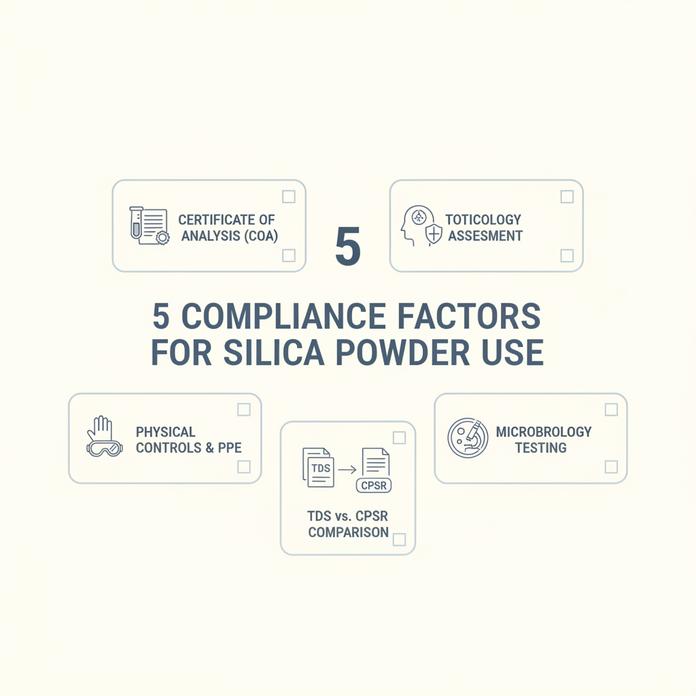
Certificate of Analysis: Verifying Purity and Oil Absorption
A solid Certificate of Analysis anchors quality control under cosmetic grade silica powder regulatory standards fda eu.
-
Core checkpoints:
- Purity
- Heavy metal limits
- Oil absorption
- Review specifications against FDA and EU cosmetic rules.
- Confirm testing methods match pharmacopeia or ISO references.
- Cross-check batch data with incoming raw material logs.
Compliance flow:
-
Documentation review
-
Supplier CoA validation
- Alignment with cosmetic grade silica powder regulatory standards fda eu
-
-
Functional testing
- Oil binding capacity
- Texture impact in formulation
Topfeel ensures every silica powder batch reflects current regulatory standards, not outdated files.
Toxicology Report and Allergen Declaration Essentials
Under cosmetic grade silica powder regulatory standards fda eu, a toxicology report supports the formal safety assessment.
Key elements:
- Hazard identification
- Risk assessment
- Exposure margin calculation
Allergen transparency matters. An accurate allergen declaration clarifies traces, even when silica itself is low-risk among cosmetic ingredients.
Compliance path:
- Ingredient profile review
- Toxicological endpoint analysis
- Regulatory compliance confirmation for FDA and EU markets
Topfeel supplies documentation ready for CPSR inclusion.
pH Value, Moisture Content, and Bulk Density Controls
Physical checks keep formulations stable and aligned with cosmetic grade silica powder regulatory standards fda eu.
Quality parameters include:
- pH value
- Moisture content
- Bulk density
Nested controls:
-
Analytical testing
-
Calibration verification
- Recorded under material specifications
-
-
Stability monitoring
- Moisture drift tracking
- Texture consistency review
Short and simple: stable powder, stable product.
Microbiological Purity Checks under EU and FDA Guidelines
Even inert powders require microbiological purity confirmation.
Under EU guidelines and FDA guidelines, labs verify:
- Microbial limits
- Absence of pathogens
- Effective contamination control
Process chain:
- Sampling protocol
- Plate count testing
- Documentation for cosmetic safety files
Clean data keeps silica powder aligned with cosmetic grade silica powder regulatory standards fda eu expectations.
Technical Data Sheet vs Cosmetic Product Safety Report (CPSR)
A Technical Data Sheet lists product specifications and ingredient information.
A Cosmetic Product Safety Report delivers the official safety assessment required in the EU.
Comparison logic:
-
TDS
- Physical properties
- Handling guidance
-
CPSR
- Toxicological profile
- Regulatory requirements confirmation
Both documents support cosmetic grade silica powder regulatory standards fda eu compliance. Used together, they simplify audits and speed product launches—exactly how Topfeel helps brands move from lab bench to shelf without compliance headaches.
Private-Label Makeup And Silica Rules
Private-label makeup sounds simple—pick a shade, press a pan, ship it out. Not quite. When cosmetic grade silica powder regulatory standards fda eu enter the conversation, sourcing, contracts, and batch control suddenly matter a lot more.
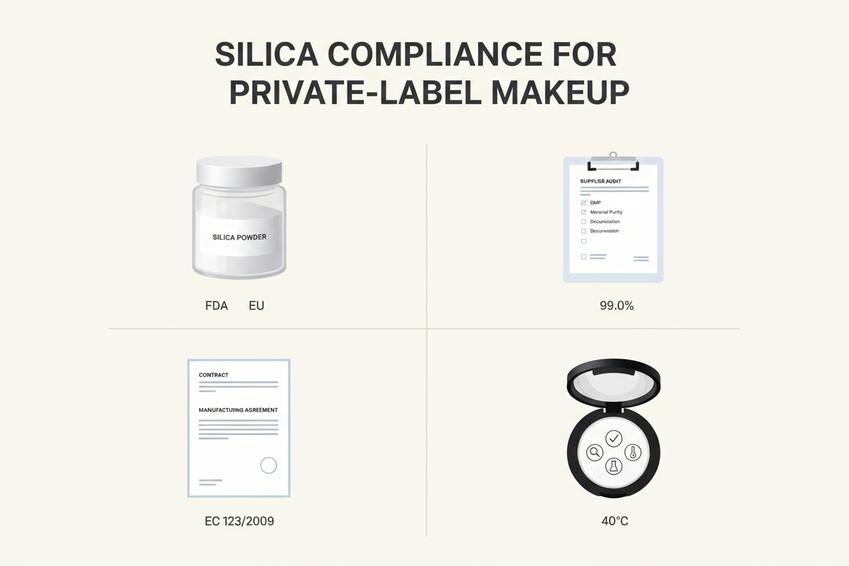
Ingredient Sourcing and Supply Chain Management Compliance
Working with raw materials like silica means mapping every supplier touchpoint against cosmetic grade silica powder regulatory standards fda eu and broader regulatory compliance rules.
-
Core checkpoints:
- Supplier qualification
- Clear ingredient specifications
- Documented traceability
- Verified import regulations
- Audit supplier history
- Confirm purity levels
- Cross-check FDA and EU cosmetic silica limits
Under a structured compliance path:
-
Supply Chain Audit Framework
-
Supplier Tier Review
- Primary silica processors
- Secondary surface-treatment vendors
-
Documentation Control
- COA validation
- Particle size distribution reports
-
Regulatory Mapping
- FDA cosmetic guidance
- EU Regulation (EC) No 1223/2009
-
Silica Quality Control Snapshot
| Parameter | FDA Expectation | EU Expectation |
|---|---|---|
| Purity (%) | ≥ 99.0 | ≥ 99.0 |
| Heavy Metals (ppm) | Within cosmetic limits | Within Annex II limits |
| Particle Size (µm) | Declared range | Declared range |
| Microbial Count | Cosmetic safe level | Cosmetic safe level |
Suppliers like Topfeel align sourcing with cosmetic grade silica powder regulatory standards fda eu, keeping paperwork tight and silica quality consistent.
Contract Manufacturing: Aligning Formulation Development with FDA/EU
A smart contract manufacturer treats formulation development as compliance engineering, not guesswork.
-
Key alignment areas:
- Regulatory guidelines
- Ingredient restrictions
- Labeling requirements
- Signed quality agreements
✓ Safety data reviewed
✓ Usage rate within cosmetic silica limits
✓ Claims backed by test data
Operational flow often looks like this:
-
Product Safety Review
- Ingredient screening against FDA lists
- EU Annex compliance check
-
Manufacturing Process Validation
- Mixing order control
- Silica dispersion uniformity
-
Documentation & Labeling
- INCI accuracy
- Warning statement verification
When building private-label powders, Topfeel ensures cosmetic grade silica powder regulatory standards fda eu are reflected directly in master formulas, not added later as a patch.
Batch Consistency and Quality Assurance in Pressed Powder Lines
Pressed powders fail quietly—until customers notice fallout or hard pan. Strong quality control prevents that.
-
Focus zones:
- Batch variation
- Testing protocols
- Product specifications
- Good manufacturing practices
Step-by-step production discipline:
- Raw silica particle size confirmation
- Pre-blend homogeneity testing
- Controlled powder pressing pressure
- Post-press stability review
Within QA systems:
-
Batch Monitoring
- Density measurement
- Oil absorption testing
-
Stability Testing
- 40°C accelerated storage
- Freeze-thaw cycles
-
Release Criteria
- Texture consistency
- Performance validation
By embedding cosmetic grade silica powder regulatory standards fda eu into routine checks, and reinforcing them through manufacturing standards, brands like Topfeel keep every compact steady, compliant, and ready for global shelves.
FDA Vs EU Silica: Quick Reference
Cosmetic brands often ask how cosmetic grade silica powder regulatory standards fda eu actually differ in daily practice. In simple terms, the US leans on post-market control, while Europe demands paperwork upfront. If you’re sourcing silica through Topfeel, understanding cosmetic grade silica powder regulatory standards fda eu keeps your launch smooth and drama-free.
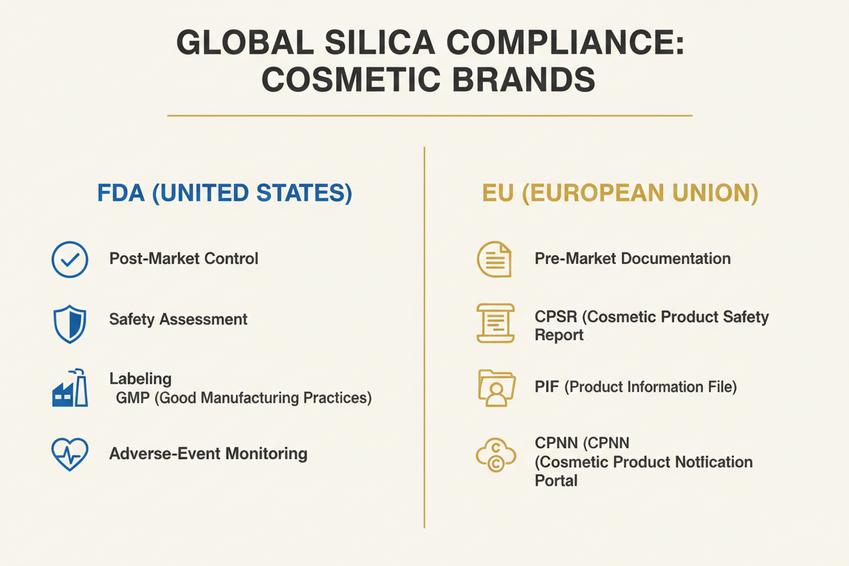
FDA Cosmetics Regulations
Under the Food and Drug Administration (FDA) in the United States (US), Cosmetic Products using Silica (ingredient) fall under the Federal Food, Drug, and Cosmetic Act (FD&C Act). No pre-approval for most cosmetics—but accountability sits squarely with the manufacturer.
-
Core Regulatory Logic
1.1 Legal Framework
- Governed by FD&C Act
- No mandatory pre-market approval (except color additives)
1.2 Manufacturer Duties
- Conduct internal Safety Assessment
- Ensure truthful Labeling Requirements
- Substantiate safety of cosmetic grade silica powder regulatory standards fda eu compliance
-
Practical Compliance Flow
- Raw material verification
- GMP alignment
- Adverse event monitoring
Key FDA Compliance Snapshot:
| Item | Requirement Type | Mandatory | Enforcement Basis |
|---|---|---|---|
| Ingredient Safety Data | Internal file | Yes | FD&C Act |
| Pre-market Approval | General cosmetics | No | FDA policy |
| Label Declaration | Public label | Yes | Labeling laws |
| Adverse Event Reporting | Post-market | Yes | MoCRA updates |
For brands like Topfeel, meeting cosmetic grade silica powder regulatory standards fda eu in the US means strong documentation—even without pre-clearance.
EU Cosmetics Regulation
Inside the European Union (EU), Cosmetics Regulation (EC) No 1223/2009 flips the script. Pre-market documentation is non-negotiable for Silica (ingredient) compliance.
Here’s how cosmetic grade silica powder regulatory standards fda eu play out in Europe:
- Mandatory Safety Assessment signed by a qualified assessor
- Complete Product Information File (PIF)
- Appointed Responsible Person in the EU
- Ingredient check via Cosing Database
- Scientific oversight referencing Scientific Committee on Consumer Safety (SCCS)
- REACH alignment
Quick comparison mindset:
- Compile CPSR
- Validate silica purity specs
- Upload CPNP notification
- Maintain PIF for 10 years
In short bursts: stricter entry, deeper files, tighter traceability.
Brands working with Topfeel often prepare once to satisfy cosmetic grade silica powder regulatory standards fda eu on both sides. Smart move. One spec sheet, dual compliance strategy, fewer headaches.
References
- heavy-metal limits – fda.gov
- EU REACH – echa.europa.eu
- INCI lists – personalcarecouncil.org
- FDA GMP – fda.gov
- ISO 22716 – iso.org
- Federal Food, Drug, and Cosmetic Act – fda.gov
- Regulation (EC) No 1223/2009 – single-market-economy.ec.europa.eu
- CPNP notification – single-market-economy.ec.europa.eu
- Cosmetic Product Safety Report – cosmeticseurope.eu
- safety assessment – cir-safety.org
- Labeling Requirements – fda.gov
- MoCRA updates – fda.gov
- Cosing Database – single-market-economy.ec.europa.eu
- Scientific Committee on Consumer Safety (SCCS) – health.ec.europa.eu
Post time: Jun-30-2026