
From Formula to Final Pack: How to Set a Makeup Expiration Date
At scale, a cosmetic expiration date shapes how makeup is stocked, shipped, and sold.
Shelf life and PAO are different clocks. Formula stability, microbes, packaging, production controls, storage, and traceability inform both decisions.
For U.S. makeup manufacturers, shelf-life decisions form part of their responsibility for product safety.
Quick Answers on Cosmetic Expiration Date
➔ Define Shelf Life: Review stability, preservation, packaging compatibility, and expected storage together.
➔ Determine PAO: Evaluate the product after opening, including use patterns and contamination exposure.
➔ Ensure Compliance: Review manufacturing controls, ingredients, labeling rules, and supporting records for the destination market.
➔ Mitigate Risks: Connect safety assessment findings with storage instructions and batch traceability.
Why Define A Cosmetic Expiration Date?
A reliable cosmetic expiration date tells buyers the intended storage period. For brands, clear dating supports appropriate labels and consistent product information.
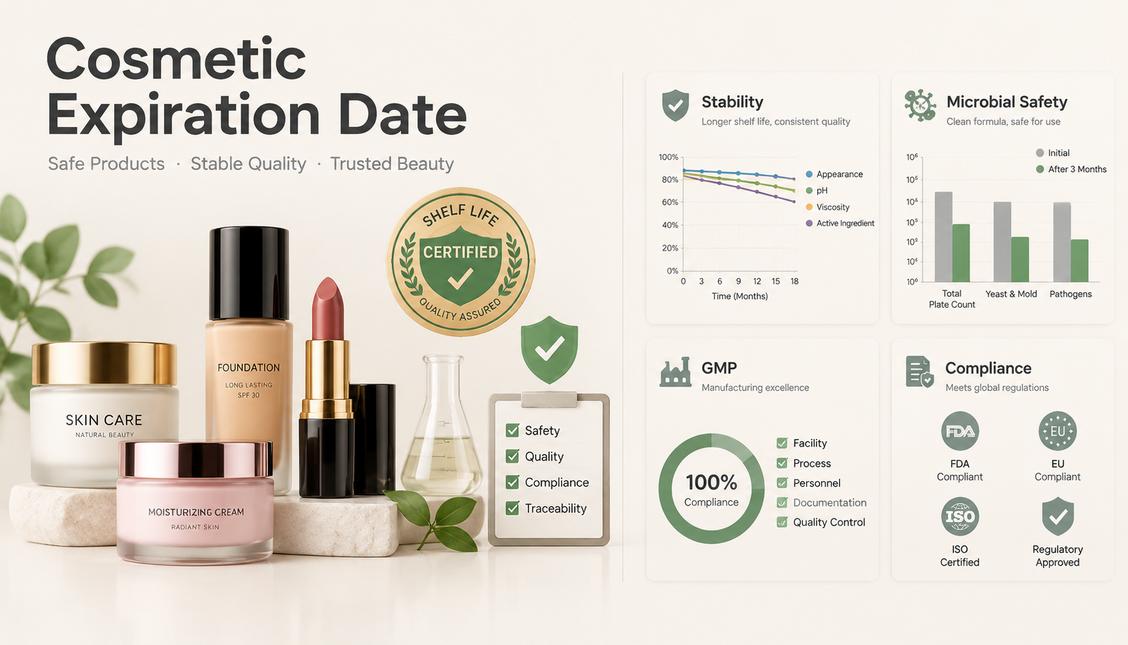
Building Consumer Trust with Documented Shelf Life
Documented shelf-life findings connect the proposed label with the tested formula and pack. Topfeel Beauty’s custom development includes compatibility, stability, and safety assessments.
- Storage evidence
- Liquid foundation checks cover separation, odor, color, and product stability.
- Pressed powder and matte lipstick need checks appropriate to their formula and packaging.
- Customer-facing evidence
- Clear dates support labeling accuracy and transparency.
- Reliable expiration information gives customers a clearer basis for comparing makeup.
Good dating makes the buying decision less guessy.
Preventing Microbial Contamination through Safety Assessment Reports
A formula’s contamination hazards belong in its safety assessment. EU manufacturers must prepare a product safety report before market placement; review product conditions and preservation alongside microbiological results.
- Assess the formula’s contamination exposure during storage and normal use.
- Examine preservative efficacy and relevant microbiological results.
- Confirm formula integrity and the production controls used for that product.
These findings inform the proposed makeup expiry date. Topfeel Beauty’s microbiological testing provides one part of the quality evidence needed for a development brief.
Meeting Good Manufacturing Practice and Ingredient Compliance
Dating decisions start before the finished item reaches the shelf.
- Production controls
- Good Manufacturing Practice covers cosmetic production, control, storage, and shipment.
- Routine quality control compares batches with defined specifications.
- Formula controls
- Ingredient reviews cover pigments, emulsifiers, preservatives, and other materials.
- Formulation guidelines define the intended combination and product requirements.
- Compliance records
- Regulatory requirements and product records guide market-specific labeling decisions.
Topfeel Beauty holds GMPC and ISO 22716 factory certifications. When evaluating a cosmetic manufacturer, connect facility credentials with the actual formula, test plan, and labeling brief.
Connect evidence with labels: Trust, microbial protection, and manufacturing compliance need a shared product brief. Topfeel Beauty’s compatibility, stability, and safety assessments help connect that brief with the formula and pack being developed.
Review custom solutions to define the evidence and labeling questions your launch needs to resolve.
5 Steps To Define Your Product’s Shelf Life
A reliable cosmetic expiration date brings stability, preservation, safety, and production records together. Changes in texture and contamination exposure inform the intended product life, while the supporting records connect those decisions with the released batch.
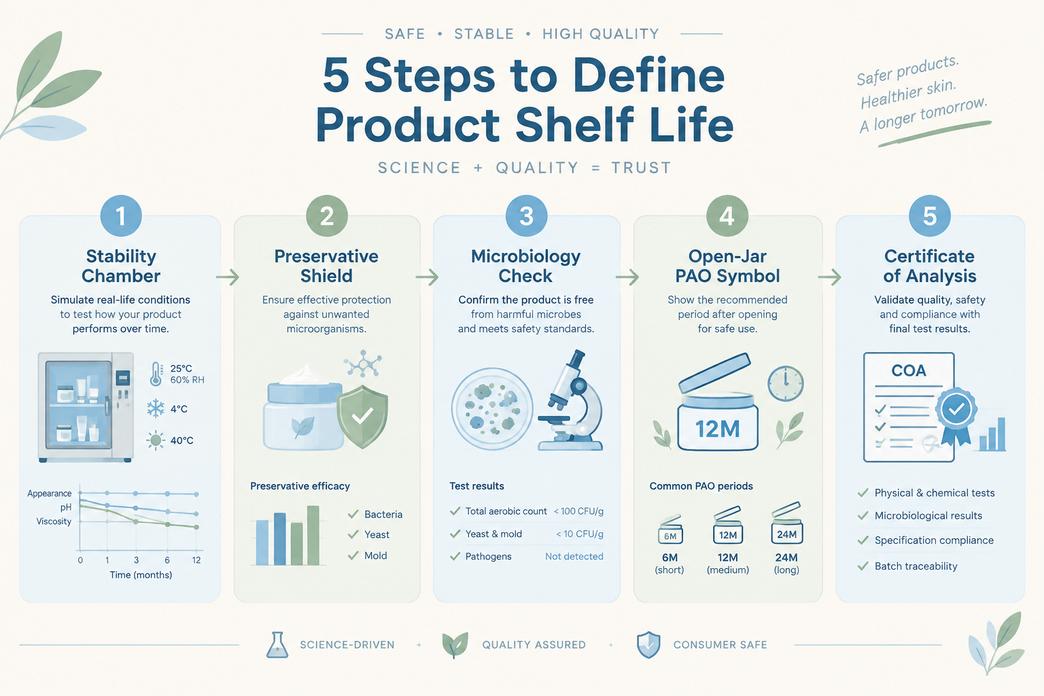
Analyze Your Formulation Stability via Accelerated Testing
Accelerated testing exposes samples to selected stress conditions.
- Controlled storage
- A temperature chamber and controlled humidity create repeatable test conditions.
- Teams monitor viscosity, color, odor, separation, and other physical changes.
- Data review
- Observed degradation informs the stability assessment alongside the wider study.
- Significant change prompts review of the proposed storage period.
Evaluate Preservative Systems and Antioxidant Compound Efficacy
Preservation and oxidative stability address different formula changes.
- Preservation checks
- An antimicrobial challenge test evaluates the product’s preservation system alongside microbiological risk assessment.
- Each preservative active ingredient needs suitability for the formula.
- Oxidative stability
- Oxidation is considered in odor, color, and formula assessments.
- Antioxidants and a chelating agent need evaluation in the complete formula.
Perform Microbiological Assays and Patch Test Verification
Microbiological work examines bacteria, fungi, and relevant contamination risks. Dermatological patch testing addresses a different safety question: skin response under the test conditions.
Neither test alone establishes a cosmetic expiration date; review the results within the complete safety and stability assessment.
Calculate Period After Opening Based on Production Batch Data
Compare batch records with expected use, packaging design, and product changes after opening. Define the opening-to-disposal timeline separately from unopened storage.
For products lasting more than 30 months, European labeling guidance uses a period-after-opening time, commonly an open-jar symbol, with exceptions for products that do not deteriorate in normal use. Unopened storage remains separate.
Record Shelf Life in a Certificate of Analysis
Final records connect the evidence with the released product.
- Product record
- production batch identification and traceability information for Great Britain labeling
- approved specification and critical parameters
- Quality evidence
- stability and microbiological test results
- quality control review and supporting documentation
- Release record
- validated cosmetic expiration date
- required compliance details and supply-chain traceability
That paper trail connects the expiration date with testing. Topfeel Beauty provides COA and MSDS documentation for its formulations; agree the required release records when developing OEM face makeup.
One connected release brief: How will the five steps defining shelf life reach your final pack?
Topfeel Beauty provides COA and MSDS for formulations and operates a 100,000-level purification workshop. Review OEM/ODM services to prepare a brief linking stability, preservation, safety, after-opening use, and release records with the product you intend to approve.
3 Risks Of Ignoring Expiration Dates
A cosmetic expiration date affects use instructions, production planning, and delivery conditions. Review eye-product contamination, batch controls, and transport together rather than treating the printed date as the only safeguard.
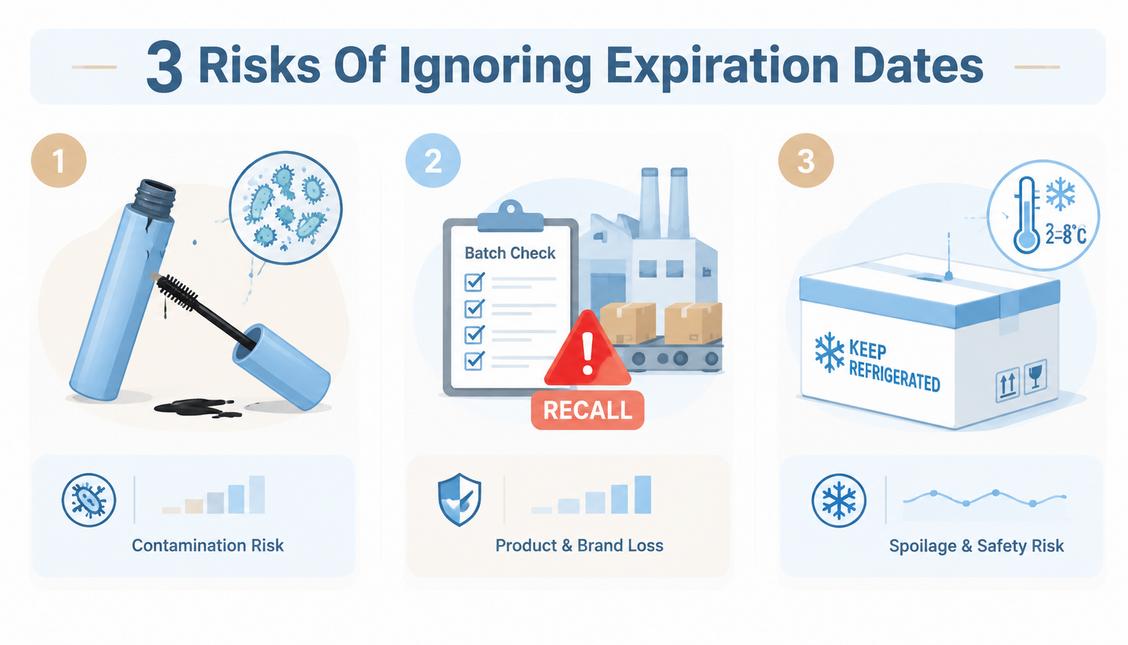
Skin Irritation from Contaminated Waterproof Mascara
Mascara’s applicator meets eyelashes and returns to the tube during use.
- Contamination risk
- Declining preservative performance belongs in the finished-product assessment.
- That contamination risk needs consideration during intended use.
- Possible user effects
- Contaminated eye cosmetics can cause infection; eye-area safety also requires attention to applicator injury and approved color additives.
- An individual’s sensitivities also matter to user comfort.
- Practical control
- Microbiological testing and packaging-compatibility checks belong in a mascara development brief.
Costly Recalls in Bulk Manufacturing without Factory Inspection
Bulk production requires quality checks before filling and packaging.
- Use batch testing to check formula consistency and contamination.
- Review the production line through a regular safety audit.
- Confirm ingredient expiration records and market requirements.
Topfeel Beauty checks incoming raw materials, performs first-article inspection, and sterilizes equipment and packaging before use. Define acceptance criteria early in private-label development.
Logistics Failures in Cold Chain Transport Leading to Degradation
Transport and storage need to match the product’s specified conditions.
- Transit controls
- Maintain the required temperature conditions across the supply chain.
- Protect products from heat exposure during freight delays; heat can weaken preservatives and encourage microbial growth.
- Warehouse controls
- Monitor specified storage conditions, including humidity where relevant.
- Use suitable pallet placement to avoid heat exposure.
- Product protection
- Poor handling conditions need assessment against the formula and final packaging.
- Stable storage conditions belong with the approved shelf life.
The expiration period depends on the specified storage conditions as well as the printed date.
What would skin irritation from contamination, batch recalls, or transport degradation cost your launch? Topfeel Beauty’s first-article inspection checks net content, color, and texture before mass production, giving buyers a defined approval checkpoint rather than waiting for finished stock.
Submit your product requirements with use, acceptance, and shipping conditions to agree the quality brief before production.
References
- Shelf Life and Expiration Dating of Cosmetics — fda.gov
- Eye Cosmetic Safety — fda.gov
- ISO 22716:2007 — Good Manufacturing Practices — iso.org
- ISO 11930:2019 — Antimicrobial Protection — iso.org
- Cosmetics Legislation — europa.eu
- Mascaras — cosmeticsinfo.org
- Understanding the Label — cosmeticseurope.eu
- Making Cosmetic Products Available in Great Britain — gov.uk
Post time: Oct-16-2026