
What Is a Basic Cosmetics List for Private Label Brands?
Chaos hits fast when product catalogs sprawl and margins slip; a basic cosmetics list cuts through the noise, giving buyers a tight, sellable core instead of a cluttered gamble that burns cash and confuses shelves.
It steadies sourcing, trims waste, and sharpens your brand voice, so launches move quicker, orders scale cleaner, and customers know exactly what they’re picking up today.
Rhythmic Rundown: Your Basic Cosmetics List
➔ Stand Out: Curate a focused product range to align with niche demands and sharpen your brand voice.
➔ Ensure Quality: Standardize formulations, partner with reliable manufacturers, and streamline quality checks.
➔ Build Trust: Offer transparent ingredient lists, clear benefits, and consistent offerings for lasting customer confidence.
Why Private Label Brands Need a Basic Cosmetics List
A smart basic cosmetics list keeps private label brands focused, clear, and easy to trust. When the product list makes sense, shoppers get it fast, and retailers feel confident placing bigger orders.
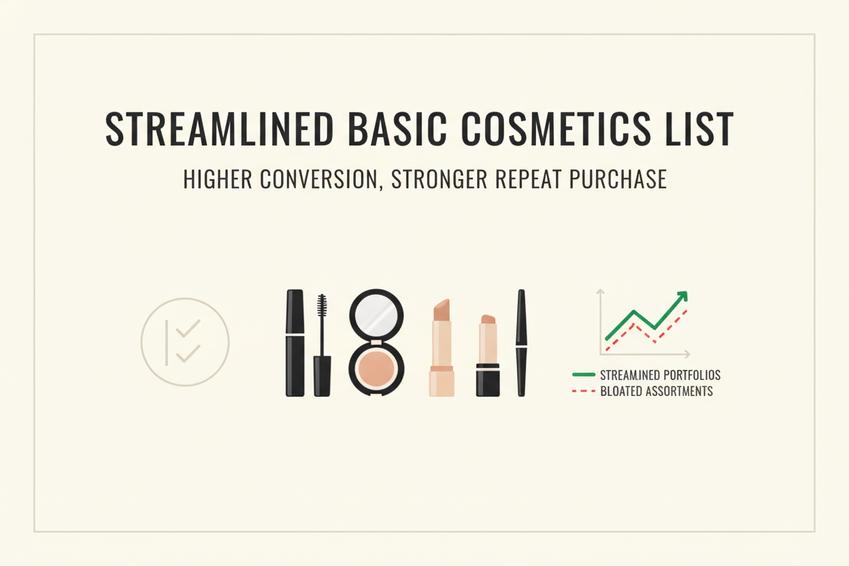
Market Differentiation Through a Curated Product Range
A tight basic cosmetics list shapes real Product uniqueness and helps brands avoid bloated catalogs.
-
Niche market alignment
-
Defined Target audience
- Skin-focused teens
- Minimalist working pros
-
Tailored Product assortment
- Core base makeup
- Everyday lip essentials
-
-
Formulation innovation
- Smart Ingredient selection
- Trend-aware Packaging design
A 2025 McKinsey beauty report noted:
Brands with streamlined portfolios and clear value propositions are outperforming overloaded assortments in both conversion and repeat purchase rates.
That insight hits home. A clean basic cosmetic list cuts confusion and keeps marketing sharp; as a cosmetic manufacturer, Topfeel Beauty offers private label solutions to support this approach. It also makes a core cosmetics list easier to scale without losing identity.
Ensuring Consistent Quality Control and Brand Reputation
Quality starts with a stable basic cosmetics list and tight Quality assurance.
- Clear Ingredient sourcing
- Defined Manufacturing standards
- Repeatable Testing protocols
- Ongoing Regulatory compliance
- Strict Product safety checks
Quality Control Snapshot
| Control Area | Standard Applied | Impact on Customer Satisfaction |
|---|---|---|
| Raw Materials | Verified Ingredient sourcing | Fewer reactions |
| Production | GMP Manufacturing standards | Batch consistency |
| Lab Testing | Stability & micro tests | Safer shelf life |
| Claims Review | Legal screening | Accurate messaging |
| Final Audit | Pre-shipment inspection | Higher Customer satisfaction |
With a stable basic makeup list, factories reduce variation. That protects brand image and keeps returns low. As a cosmetic supplier, Topfeel Beauty follows established quality assurance measures, including ISO 22716 guidelines, to help maintain steady production results.
Building Customer Trust with Transparent Offerings
Trust grows when a basic cosmetics list feels open and honest.
-
Ingredient transparency
- Full INCI disclosure
- Clear Allergen information
-
Ethical backbone
- Responsible Ethical sourcing
- Visible Sustainability practices
-
Proof points
- Third-party Certifications
- Accurate Product claims
When shoppers see clear labeling and real Consumer education, hesitation drops. A well-explained basic cosmetics list turns curious browsers into loyal fans. Keep it simple. Keep it honest. That’s how a brand earns long-term respect.
4 Steps to Build Your Basic Cosmetics List
Building a basic cosmetics list sounds simple, but getting it right takes clarity and a bit of street smarts. From shaping your vibe to testing real samples, every move shapes how your basic cosmetic lineup performs. If you want a basic makeup list that actually sells, not just sits pretty, start here.
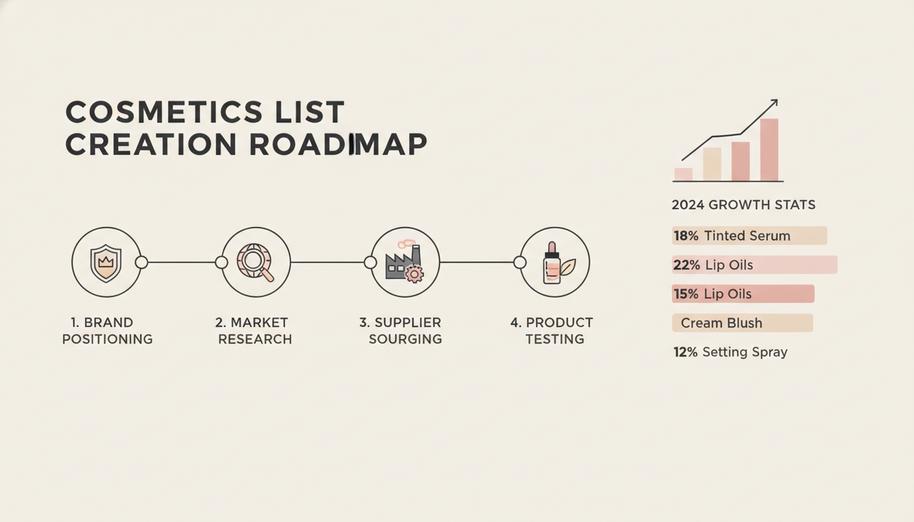
Step 1: Define Your Brand Positioning and Target Audience
A strong basic cosmetics list begins with sharp Brand identity and clear Brand values. No fuzzy ideas. No random picks.
- Define your Market niche
- Clarify your Brand story
- Outline core Consumer needs
Then go deeper:
- Map Target demographics
- Match pricing to Positioning
- Align packaging with lifestyle habits
For example:
- Young urban buyers → lightweight foundation, lip tints
- Working professionals → long-wear base, neutral palettes
- Students → affordable starter basic makeup products list
When your Brand positioning clicks, your basic cosmetic list stops being generic and starts feeling intentional. That clarity helps partners like Topfeel Beauty align formulation and packaging with your market direction.
Step 2: Research Market Demand and Trending Formulations
A smart basic cosmetics list reflects current Market trends and rising Ingredient trends.
Key checks:
- Review Consumer preferences
- Study Competitor analysis
- Track emerging Formulation types
Recent market signals show steady growth in skin-first makeup:
| Product Category | 2024 Growth Rate | Key Ingredient Trend |
|---|---|---|
| Tinted Serum | 18% | Hyaluronic Acid |
| Lip Oils | 22% | Plant Oils |
| Cream Blush | 15% | Vitamin E |
| Setting Spray | 12% | Niacinamide |
McKinsey’s 2025 global beauty update notes that “hybrid makeup with skincare benefits continues to outperform traditional color cosmetics across key markets.”
That insight matters. A modern basic makeup list should include hybrid base products, multitasking lip items, and breathable formulas. Topfeel Beauty offers trend-setting, market-ready formulas, helping brands react faster to trend shifts.
Step 3: Source Reliable Manufacturers and Suppliers
Your basic cosmetics list is only as good as the people producing it.
Focus areas:
-
Vet Manufacturing partners
- Audit Production capabilities
- Confirm scalability
-
Review Supplier selection
- Ethical Ingredient sourcing
- Stable Lead times
-
Strengthen Quality control
- Batch testing
- Stability reports
- Regulatory compliance
Look for proof, not promises. Certificates, lab reports, export records.
A cosmetic manufacturer like Topfeel Beauty incorporates a multi-step inspection process early, which reduces reformulation risks and shortens launch cycles for your basic cosmetic list.
Step 4: Test Products, Gather Feedback, Refine Your Line
Testing turns a draft basic cosmetics list into a market-ready lineup.
Start with controlled Product testing:
- Shade matching trials
- Wear tests (8–10 hours)
- Climate stability checks
Collect Consumer feedback in layers:
- Texture and blendability
- Packaging usability
- Repurchase intent
Then move into Product refinement:
- Adjust pigments through targeted Formulation adjustments
- Improve pump or applicator for better User experience
- Plan continuous Product iteration
Short loops work best. Test. Adjust. Test again.
That’s how a simple basic cosmetics list evolves into a reliable basic makeup products list customers trust—and keep coming back for.
Skin Care vs. Color Cosmetics: What to Include?
Building a basic cosmetics list can feel confusing when you’re deciding between skin care and makeup. Some shoppers want glow and protection; others want color and fun. A smart basic cosmetics list balances both, keeping your cosmetics list practical while still trend-aware. Here’s how to shape basic cosmetics that actually sell.
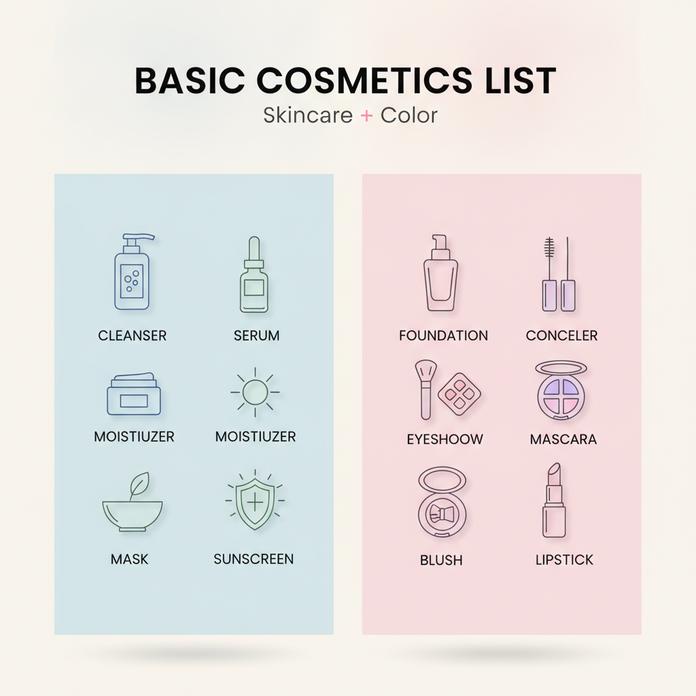
Skin Care
A strong basic cosmetics list always starts with skin health. Think daily use, repeat purchase, steady demand.
-
Core Daily Essentials
-
Cleansing
- Cleanser for oil control or hydration
- Toner to rebalance after washing
-
Treatment
- Serum targeting brightening or firming
- Eye cream for puffiness and fine lines
-
Protection
- Moisturizer to lock in hydration
- Sunscreen for daily UV defense
-
-
Weekly Boosters
-
Deep Care
- Mask for intensive repair
- Exfoliant to smooth texture
-
For brands shaping a basic cosmetics list, skin care builds trust. It keeps customers coming back because results show up in real life. For brands exploring formulation, Topfeel Beauty offers skincare samples alongside its core color cosmetics catalog to layer into a cosmetics list.
Color Cosmetics
Color adds personality to a basic cosmetics list. It’s where trends move fast and margins can shine.
• Base: Foundation, Concealer
• Eyes: Eyeshadow, Mascara, Eyeliner
• Cheeks: Blush
Here’s the simple flow:
- Even the tone with foundation.
- Brighten using concealer.
- Define eyes.
- Finish with lip color.
Some buyers focus on hero shades; others prefer everyday neutrals. A balanced cosmetics list mixes both. Topfeel Beauty supports brands that want reliable base products plus trend-driven pops, keeping every basic cosmetics list current without overwhelming inventory.
Ingredients Checklist for a Basic Cosmetics List
Building a basic cosmetics list doesn’t have to feel overwhelming. Break it down into actives, base ingredients, protection systems, and sensory extras. When you organize a cosmetics ingredient list this way, even a simple basic makeup and skincare list starts making real sense.
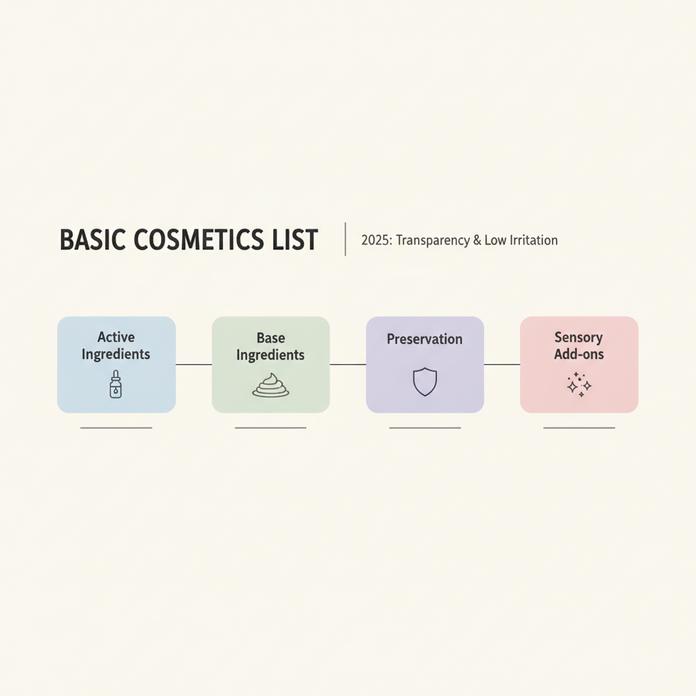
Active Ingredients for Efficacy and Performance
A smart basic cosmetics list starts with performance drivers. These are the ingredients that actually do the heavy lifting.
-
Skin renewal and resurfacing
- Retinoids improve cell turnover.
- AHAs refine texture.
- Salicylic Acid clears pores.
-
Hydration and barrier support
- Hyaluronic Acid binds water.
- Niacinamide strengthens the barrier.
- Peptides improve firmness signals.
-
Brightening and antioxidant defense
- Vitamin C boosts radiance.
- Antioxidants neutralize free radicals.
When reviewing a cosmetics product checklist, ask:
- Is the active clinically backed?
- Is the concentration realistic?
- Is it stable in this formula?
A practical basic beauty product list usually combines one resurfacer, one hydrator, and one antioxidant. Keep it tight. More isn’t always better.
Functional Bases: Emollients, Humectants, Thickeners
Without a solid base, even the best actives flop. A well-built basic cosmetics list balances feel, spread, and stability.
Core building blocks include:
- Glycerin for water retention
- Shea Butter and Jojoba Oil for softness
- Dimethicone and Squalane for slip
Texture controllers matter too:
-
Structure agents
- Cetyl Alcohol for cream body
- Carbomer for gel structure
- Xanthan Gum for natural thickening
-
Sensory tuning
- Light oils → fast absorption
- Butters → richer finish
- Silicones → smooth glide
A reliable cosmetics essentials list keeps humectants around 3–10% and balances oils so skin feels nourished, not greasy. That’s the sweet spot people actually stick with.
Preservatives and Stabilizers for Shelf-Life Safety
Safety isn’t optional in any basic cosmetics list. Protection systems prevent spoilage and maintain pH balance.
| Ingredient | Typical Use Level (%) | Primary Role | Stability Support |
|---|---|---|---|
| Phenoxyethanol | 0.5–1.0 | Broad-spectrum preservative | Heat stable |
| Sodium Benzoate | 0.2–0.5 | Yeast & mold control | Works best below pH 5.5 |
| Potassium Sorbate | 0.1–0.3 | Fungal protection | Acidic systems |
| Benzyl Alcohol | 0.5–1.0 | Preservative & solvent | Wide compatibility |
Support players:
- EDTA enhances preservative efficiency
- Citric Acid adjusts pH
- Tocopherol slows oxidation
Some brands still use Parabens due to stability and cost efficiency, though consumer demand often shifts choices. Any solid cosmetics product list weighs safety data, regulatory rules, and formula type before locking in a system.
Fragrance, Colorants, and Other Additives
These extras shape the vibe of a basic cosmetics list, but they need careful handling.
-
Fragrance options
- Essential Oils for natural positioning
- Synthetic Fragrance for consistency
-
Visual enhancers
- Mica for shimmer
- Iron Oxides for tone
- Titanium Dioxide for opacity
-
Functional extras
- Botanical Extracts for story appeal
- pH Adjusters for skin compatibility
“Consumers in 2025 are prioritizing ingredient transparency and low-irritation formulas, especially in daily-use skincare,” notes Mintel’s Global Beauty and Personal Care Report (2025).
In a starter cosmetics list or basic makeup essentials list, keep fragrance low, colorants compliant, and extracts backed by safety data. Flashy is fun. Safe and stable is smarter.
Basic Cosmetics List Cost Estimates
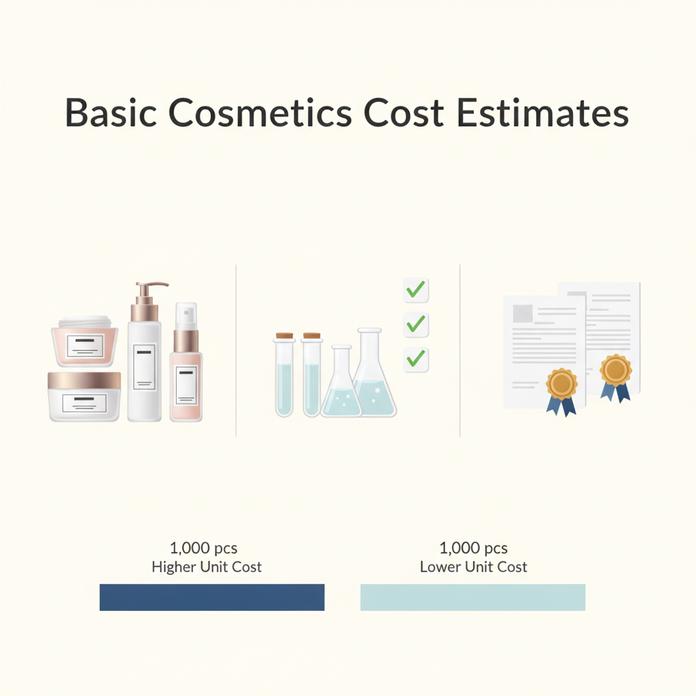
Building a basic cosmetics list sounds simple, yet the real cost story sits behind every jar, pump, and formula. A smart basic cosmetics list balances packaging, ingredients, and compliance so your margins stay healthy. Brands like Topfeel Beauty know that a clear cosmetics cost list keeps surprises low and profits steady.
Packaging Costs: Bottles, Jars, Labels
In any basic cosmetics list, Packaging often eats up visible budget share. It covers:
- Bottles
- Jars
- Labels
- Containers
- Caps and Pumps
Cost drivers break down like this:
-
Materials
- Glass
- PET plastic
- Airless systems
-
Decoration
- Silk print
- Hot stamping
Deeper cost layers include:
-
Unit price by volume
- 1,000 pcs: higher per-unit
- 10,000 pcs: lower per-unit
-
Custom mold fees
- One-time tooling
- Design revisions
A tight basic cosmetics list keeps packaging aligned with brand tone. In collaboration with its packaging division, Topfeel Beauty provides custom mold development and design support to help balance look and spend.
Formulation and Production Expenses
Your basic cosmetics list must account for Formulation and Production realities.
Core spending areas:
-
Ingredients
- Active compounds
- Preservatives
- Fragrance
-
Manufacturing
- Blending
- Filling
-
Raw materials storage
Cost flow usually runs:
- Concept brief
- Lab Development
- Pilot batch
- Mass production
Short notes that matter:
- Small batches raise labor cost.
- Complex Formulation increases testing rounds.
- Automated Filling reduces waste.
A practical cosmetics product list stays flexible. Topfeel Beauty follows a structured production workflow so a starter basic cosmetics list doesn’t spiral out of control.
Testing, Compliance, and Certification Fees
No basic cosmetics list is complete without Testing and Compliance budgeting.
Key layers:
- Safety assessment
- Stability testing
- Microbial testing
- Claims verification
Regulatory structure:
-
Local Regulations
- Ingredient review
- Label check
-
International Standards
- EU CPNP
- FDA filing
Documentation stack:
-
Product Information File
- Formula data
- Quality reports
-
Certification records
Skipping this step is risky. A well-prepared cosmetics essentials list factors in Documentation early. Topfeel Beauty provides formulations designed to comply with EU and FDA regulations, keeping launches smooth and retail-ready.
References
- McKinsey beauty report – mckinsey.com / McKinsey & Company
- Product safety – fda.gov / U.S. Food and Drug Administration
- GMP Manufacturing standards – iso.org / International Organization for Standardization
- INCI disclosure – incidecoder.com / INCI Decoder
- Ethical sourcing – ethicaltrade.org / Ethical Trading Initiative
- Hyaluronic Acid – clevelandclinic.org / Cleveland Clinic
- Niacinamide – healthline.com / Healthline Media
- Retinoids – ncbi.nlm.nih.gov / National Institutes of Health
- Vitamin C – health.harvard.edu / Harvard Health
- Glycerin – pubchem.ncbi.nlm.nih.gov / PubChem
- Shea Butter – medicalnewstoday.com / Medical News Today
- Phenoxyethanol – cosmeticsinfo.org / Cosmetics Info
- Parabens – fda.gov / U.S. Food and Drug Administration
- Mintel’s Global Beauty and Personal Care Report – mintel.com / Mintel Group Ltd
Post time: Jul-08-2026